मराठी

Consider a circular loop of wire lying in the plane of the table. Let the current pass through the loop clockwise. - Science

Advertisements
Advertisements

प्रश्न

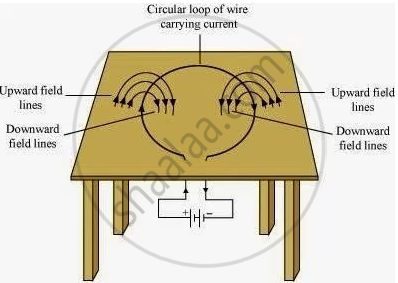
Consider a circular loop of wire lying in the plane of the table. Let the current pass through the loop clockwise. Apply the right-hand rule to find out the direction of the magnetic field inside and outside the loop.

थोडक्यात उत्तर
Advertisements

उत्तर

Inside the loop = Pierce inside the table
Outside the loop = Appear to emerge out from the table
For downward direction of current flowing in the circular loop, the direction of magnetic field lines will be as if they are emerging from the table outside the loop and merging in the table inside the loop. Similarly, for upward direction of current flowing in the circular loop, the direction of magnetic field lines will be as if they are emerging from the table outside the loop and merging in the table inside the loop, as shown in the given figure.
 

shaalaa.com
  या प्रश्नात किंवा उत्तरात काही त्रुटी आहे का?
पाठ 13: Magnetic Effects of Electric Current - Intext Questions [पृष्ठ २२९]

APPEARS IN

एनसीईआरटी Science [English] Class 10
पाठ 13 Magnetic Effects of Electric Current
Intext Questions | Q 1 | पृष्ठ २२९

संबंधित प्रश्‍न

Imagine that you are sitting in a chamber with your back to one wall. An electron beam, moving horizontally from back wall towards the front wall, is deflected by a strong magnetic field to your right side. What is the direction of magnetic field?


State the rule to determine the direction of a force experienced by a current-carrying straight conductor placed in a magnetic field which is perpendicular to it.


Name the rule for finding the direction of magnetic field produced by a straight current-carrying conductor.


What type of core should be put inside a current-carrying solenoid to make an electromagnet?


The front face of a circular wire carrying current behaves like a north pole. The direction of current in this face of circular wire is:

(a) clockwise
(b) downwards
(c) anticlockwise
(d) upwards


 Name one device whose working depends on the force exerted on a current-carrying coil placed in a magnetic field. 


State Fleming's left-hand rule. Explain it with the help of labelled diagrams.


A current flows in a wire running between the S and N poles of a magnet lying horizontally as shown in Figure below: 

The force on the wire due to the magnet is directed: 

fron N to S
 from S to N
 vertically downwards
 vertically upwards


 force experienced by a current-carrying straight conductor placed in a magnetic field which is perpendicular to it. 


Name three factors on which the magnitude of force on a current carrying conductor placed in a magnetic field depends and state how does the force depend on the factors stated by you.


Name the following diagram and explain the concept behind it.


Name and state the rule of determine the direction of force experienced by a current carrying straight conductor placed in a uniform magnetic field which is perpendicular to it. 


State Fleming’s left-hand rule.


A flat coil ABCD is freely suspended between the pole of a U-shaped permanent magnet with the plane of coil parallel to the magnetic field.

Name an instrument which makes use of the principle stated above.


The following diagram shows two parallel straight conductors carrying the same current. Copy the diagram and draw the pattern of the magnetic field lines around them showing their directions. What is the magnitude of the magnetic field at a point 'X' which is equidistant from the conductors? Give justification for your answer.


State whether a magnetic field is associated or not around a moving charge.


Describe the activity that shows that a current-carrying conductor experiences a force perpendicular to its length and the external magnetic field. How does Fleming’s left-hand rule help us to find the direction of the force acting on the current carrying conductor?


What do you know about Michael Faraday?


A copper conductor is placed over two stretched copper wires whose ends ate connected to a D.C. supply as shown in the diagram.

  1. What should be the magnetic poles at the points A and B lying on either side of the conductor to experience the force in the upward direction?
  2. Name the law used to find these polarities.


Share
Notifications

Englishहिंदीमराठी


      Forgot password?
Use app×