English

Consider a circular loop of wire lying in the plane of the table. Let the current pass through the loop clockwise. - Science

Advertisements
Advertisements

Question

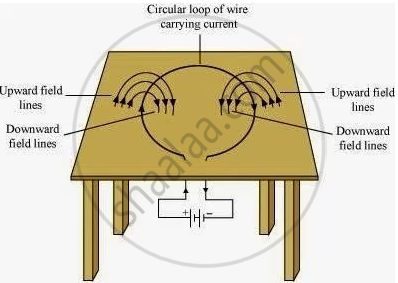
Consider a circular loop of wire lying in the plane of the table. Let the current pass through the loop clockwise. Apply the right-hand rule to find out the direction of the magnetic field inside and outside the loop.

Answer in Brief
Advertisements

Solution

Inside the loop = Pierce inside the table
Outside the loop = Appear to emerge out from the table
For downward direction of current flowing in the circular loop, the direction of magnetic field lines will be as if they are emerging from the table outside the loop and merging in the table inside the loop. Similarly, for upward direction of current flowing in the circular loop, the direction of magnetic field lines will be as if they are emerging from the table outside the loop and merging in the table inside the loop, as shown in the given figure.
 

shaalaa.com
  Is there an error in this question or solution?
Chapter 13: Magnetic Effects of Electric Current - Intext Questions [Page 229]

APPEARS IN

NCERT Science [English] Class 10
Chapter 13 Magnetic Effects of Electric Current
Intext Questions | Q 1 | Page 229

RELATED QUESTIONS

Imagine that you are sitting in a chamber with your back to one wall. An electron beam, moving horizontally from back wall towards the front wall, is deflected by a strong magnetic field to your right side. What is the direction of magnetic field?


Name the rule for finding the direction of magnetic field produced by a straight current-carrying conductor.


Draw a sketch to show the magnetic lines of force due to a current-carrying straight conductor.


Name and state the rule to determine the direction of magnetic field around a straight current-carrying conductor.


 What are the various ways in which the strength of magnetic field produced by a current-carrying circular coil can be increased?


Name any two factors on which the strength of magnetic field produced by a current-carrying solenoid depends. How does it depend on these factors?


A current-carrying conductor is held in exactly vertical direction. In order to produce a clockwise magnetic field around the conductor, the current should passed in the conductor:

(a) from top towards bottom
(b) from left towards right
(c) from bottom towards top
(d) from right towards left 


For Fleming's left-hand rule, write down the three things that are 90° to each other, and next to each one write down the finger or thumb that represents it.


If the current in a wire is flowing in the vertically downward direction and a magnetic field is applied from west to east, what is the direction of force in the wire?


What is the force on a current-carrying wire that is parallel to a magnetic field? Give reason for your answer. 


State two ways to increase the speed of rotation of a D.C. motor.


Differentiate between conductors and insulators.


State whether a magnetic field is associated or not around a static charge.


State under what conditions force acting on a current carrying conductor which is freely suspended in a magnetic field can be maximum.


Write Fleming’s left hand rule.


A current-carrying conductor is held in an exactly vertical direction. In order to produce a clockwise magnetic field around the conductor, the current should be passed in the conductor:


The diagram below shows a free conductor AB is kept in a magnetic field and is carrying current from A to B. (To avoid confusion complete path of the circuit is not shown) The direction of the force experienced by the conductor will be:


A current-carrying conductor of a certain length, kept perpendicular to the magnetic field experiences a force F. What will be the force if the current is increased four times, the length is halved and the magnetic field is tripled?


A copper wire is held between the poles of a magnet

The current in the wire can be reversed. The pole of the magnet can also be changed over. In how many of the four directions shown can the force act on the wire?


Share
Notifications

Englishहिंदीमराठी


      Forgot password?
Use app×