Advertisements
Advertisements
Question
Observe the following figure:

If the current in the coil A is changed, will some current be induced in the coil B? Explain.
Advertisements
Solution
A current will be induced in Coil B. When there is a change in the current in Coil A, a magnetic field is associated with it. This induces a potential difference between the two coils which gives rise to a current in Coil B. This change can be noted by observing the deflection in the galvanometer.
APPEARS IN
RELATED QUESTIONS
Consider a circular loop of wire lying in the plane of the table. Let the current pass through the loop clockwise. Apply the right-hand rule to find out the direction of the magnetic field inside and outside the loop.
Which of the following property of a proton can change while it moves freely in a magnetic field? (There may be more than one correct answer.)
Which of the following property of a proton can change while it moves freely in a magnetic field? (There may be more than one correct answer.)
State whether the following statement is true or false
The field at the centre of a long circular coil carrying current will be parallel straight lines.
Imagine that you are sitting in a chamber with your back to one wall. An electron beam, moving horizontally from back wall towards the front wall, is deflected by a strong magnetic field to your right side. What is the direction of magnetic field?
Name and state the rule to determine the direction of magnetic field around a straight current-carrying conductor.
Draw the magnetic lines of force due to a circular wire carrying current.
What are the various ways in which the strength of magnetic field produced by a current-carrying circular coil can be increased?
What is a solenoid?
What type of core should be put inside a current-carrying solenoid to make an electromagnet?
A current-carrying straight wire is held in exactly vertical position. If the current passes through this wire in the vertically upward direction, what is the direction of magnetic field produced by it? Name the rule used to find the direction of magnetic field.
The magnetic field associated with a current-carrying straight conductor is in anticlockwise direction. If the conductor was held along the east-west direction, what will be the direction of current through it? Name and state the rule applied to determine the direction of current?
A current-carrying conductor is held in exactly vertical direction. In order to produce a clockwise magnetic field around the conductor, the current should passed in the conductor:
(a) from top towards bottom
(b) from left towards right
(c) from bottom towards top
(d) from right towards left
In a statement of Fleming's left-hand rule, what do the following represent?
(a) direction of centre finger.
(b) direction of forefinger.
(c) direction of thumb.
A current-carrying conductor is placed perpendicularly in a magnetic field. Name the rule which can be used to find the direction of force acting on the conductor.
State two ways to increase the force on a current-carrying conductor in a magnetic held.
Name one device whose working depends on the force exerted on a current-carrying coil placed in a magnetic field.
If the current in a wire is flowing in the vertically downward direction and a magnetic field is applied from west to east, what is the direction of force in the wire?
Name three factors on which the magnitude of force on a current carrying conductor placed in a magnetic field depends and state how does the force depend on the factors stated by you.
State condition when magnitude of force on a current carrying conductor placed in a magnetic field is maximum?
Name the following diagram and explain the concept behind it.
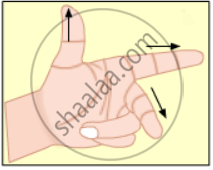
i) Which principle is explained in this figure?
ii) Which rule is used to find out the direction of a force in this principle?
iii) In which machine this principle is used? Draw a diagram showing working of that machine
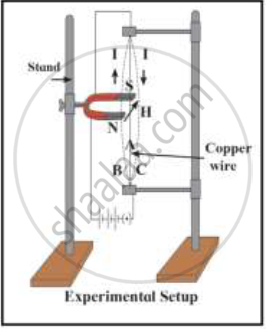
State two ways to increase the speed of rotation of a D.C. motor.
Name and state the rule of determine the direction of force experienced by a current carrying straight conductor placed in a uniform magnetic field which is perpendicular to it.
State Fleming’s left-hand rule.
A flat coil ABCD is freely suspended between the pole of a U-shaped permanent magnet with the plane of coil parallel to the magnetic field.
When will coil come to rest?
The following diagram shows two parallel straight conductors carrying the same current. Copy the diagram and draw the pattern of the magnetic field lines around them showing their directions. What is the magnitude of the magnetic field at a point 'X' which is equidistant from the conductors? Give justification for your answer.
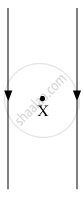
State whether a magnetic field is associated or not around a static charge.
State whether a magnetic field is associated or not around a moving charge.
The north pole of Earth’s magnet is in the ____________.
The diagram below shows a free conductor AB is kept in a magnetic field and is carrying current from A to B. (To avoid confusion complete path of the circuit is not shown) The direction of the force experienced by the conductor will be:
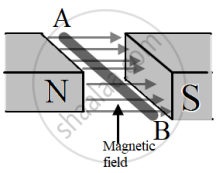
A copper wire is held between the poles of a magnet
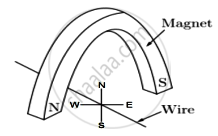
The current in the wire can be reversed. The pole of the magnet can also be changed over. In how many of the four directions shown can the force act on the wire?
Assertion (A): A current carrying straight conductor experiences a force when placed perpendicular to the direction of magnetic field.
Reason (R): The net charge on a current carrying conductor is always zero.
Two LED bulbs of 10W and 5W are connected in series. If the current flowing through 5W bulb is 0.005A, the current flowing through 10W bulb is ______.
