Advertisements
Advertisements
Questions
Write Fleming’s left hand rule.
Write the laws of Fleming’s left-hand rule.
Advertisements
Solution
Stretch the index finger, the middle finger, and the thumb of the left hand mutually perpendicular to each other. If the index finger is in the direction of the magnetic field and the middle finger points in the direction of the current, then the thumb will point towards the direction of the force on the conductor.
APPEARS IN
RELATED QUESTIONS
Consider a circular loop of wire lying in the plane of the table. Let the current pass through the loop clockwise. Apply the right-hand rule to find out the direction of the magnetic field inside and outside the loop.
The magnetic field in a given region is uniform. Draw a diagram to represent it.
The magnetic field inside a long straight solenoid-carrying current ______.
Which of the following property of a proton can change while it moves freely in a magnetic field? (There may be more than one correct answer.)
Which of the following correctly describes the magnetic field near a long straight wire?
State whether the following statement is true or false
The field at the centre of a long circular coil carrying current will be parallel straight lines.
When is the force experienced by a current-carrying conductor placed in a magnetic field largest?
State the rule to determine the direction of a force experienced by a current-carrying straight conductor placed in a magnetic field which is perpendicular to it.
Observe the following figure:

If the current in the coil A is changed, will some current be induced in the coil B? Explain.
State qualitatively the effect of inserting an iron core into a current-carrying solenoid.
Name the rule for finding the direction of magnetic field produced by a straight current-carrying conductor.
State the form of magnetic field lines around a straight current-carrying conductor.
What is the shape of a current-carrying conductor whose magnetic field pattern resembles that of a bar magnet?
Describe how you will locate a current-carrying wire concealed in a wall.
Draw a sketch to show the magnetic lines of force due to a current-carrying straight conductor.
Name any two factors on which the strength of magnetic field produced by a current-carrying solenoid depends. How does it depend on these factors?
What is a solenoid?
What type of core should be put inside a current-carrying solenoid to make an electromagnet?
A soft iron bar is inserted inside a current-carrying solenoid. The magnetic field inside the solenoid:
(a) will decrease
(b) will increase
(c) will become zero
(d) will remain the same
When is the force experienced by a current-carrying conductor placed in a magnetic field largest?
State condition when magnitude of force on a current carrying conductor placed in a magnetic field is zero?
A coil ABCD mounted on an axle is placed between the poles N and S of a permanent magnet as shown in Figure.
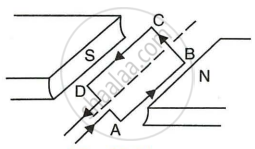
- In which direction will the coil begin to rotate when current is passed through the coil in direction ABCD by connecting a battery at the ends A and D of the coil?
- Why is a commutator necessary for continuous rotation of the coil?
- Complete the diagram with commutator, etc. for the flow of current in the coil?
A flat coil ABCD is freely suspended between the pole of a U-shaped permanent magnet with the plane of coil parallel to the magnetic field.
When will coil come to rest?
State under what conditions force acting on a current carrying conductor which is freely suspended in a magnetic field can be maximum.
State under what conditions force acting on a current carrying conductor which is freely suspended in a magnetic field can be Zero.
Which of the following factors affect the strength of force experience by current-carrying conduct in a uniform magnetic field?
The diagram below shows a free conductor AB is kept in a magnetic field and is carrying current from A to B. (To avoid confusion complete path of the circuit is not shown) The direction of the force experienced by the conductor will be:
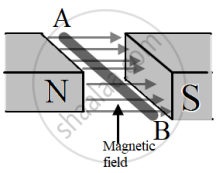
What does the direction of thumb indicate in the right-hand thumb rule. In what way this rule is different from Fleming’s left-hand rule?
Describe the activity that shows that a current-carrying conductor experiences a force perpendicular to its length and the external magnetic field. How does Fleming’s left-hand rule help us to find the direction of the force acting on the current carrying conductor?
Assertion (A): A current carrying straight conductor experiences a force when placed perpendicular to the direction of magnetic field.
Reason (R): The net charge on a current carrying conductor is always zero.
If the strength of the current flowing through a wire is increased, the strength of the magnetic field produced by it ______.
A copper conductor is placed over two stretched copper wires whose ends ate connected to a D.C. supply as shown in the diagram.
- What should be the magnetic poles at the points A and B lying on either side of the conductor to experience the force in the upward direction?
- Name the law used to find these polarities.

