Advertisements
Advertisements
Question
Name and state the law which is used to determine the direction of force on a current carrying conductor placed in a magnetic field.
Advertisements
Solution
Fleming's left hand rule: Stretch the forefinger, middle finger and the thumb of your left hand mutually perpendicular to each other. If the forefinger indicates the direction of magnetic field and the middle finger indicates the direction of current, then the thumb will indicate the direction of motion of conductor.
RELATED QUESTIONS
Name the rule for finding the direction of magnetic field produced by a straight current-carrying conductor.
Draw the magnetic lines of force due to a circular wire carrying current.
What is the shape of field lines inside a current-carrying solenoid? What does the pattern of field lines inside a current-carrying solenoid indicate?
State two ways to increase the force on a current-carrying conductor in a magnetic held.
A current flows in a wire running between the S and N poles of a magnet lying horizontally as shown in Figure below:
The force on the wire due to the magnet is directed:
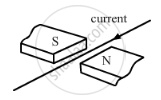
fron N to S
from S to N
vertically downwards
vertically upwards
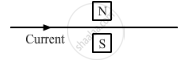
Which way does the wire in the diagram below tend to move?
Name the following diagram and explain the concept behind it.
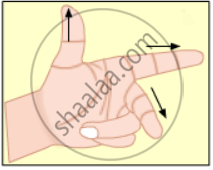
The north pole of Earth’s magnet is in the ____________.
The direction of force on a current carrying conductor in a magnetic field is given by ____________.
Assertion (A): A current carrying straight conductor experiences a force when placed perpendicular to the direction of magnetic field.
Reason (R): The net charge on a current carrying conductor is always zero.
