Advertisements
Advertisements
Question
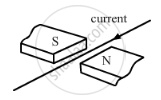
A current flows in a wire running between the S and N poles of a magnet lying horizontally as shown in Figure below:
The force on the wire due to the magnet is directed:
fron N to S
from S to N
vertically downwards
vertically upwards
Advertisements
Solution
vertically downwards
Using Fleming's left-hand rule, we find that the force on wire should act vertically downwards.
APPEARS IN
RELATED QUESTIONS
Consider a circular loop of wire lying in the plane of the table. Let the current pass through the loop clockwise. Apply the right-hand rule to find out the direction of the magnetic field inside and outside the loop.
The magnetic field in a given region is uniform. Draw a diagram to represent it.
Observe the following figure:

If the current in the coil A is changed, will some current be induced in the coil B? Explain.
Name the rule for finding the direction of magnetic field produced by a straight current-carrying conductor.
Fill in the following blank with suitable words:
For a current-carrying solenoid, the magnetic field is like that of a ...........
Draw a sketch to show the magnetic lines of force due to a current-carrying straight conductor.
What happens when a current-carrying conductor is placed in a magnetic field?
When is the force experienced by a current-carrying conductor placed in a magnetic field largest?
For Fleming's left-hand rule, write down the three things that are 90° to each other, and next to each one write down the finger or thumb that represents it.
If the current in a wire is flowing in the vertically downward direction and a magnetic field is applied from west to east, what is the direction of force in the wire?
Two coils A and B of insulated wire are kept close to each other. Coil A is connected to a galvanometer while coil B is connected to a battery through a key. What would happen if:
the current is stopped by removing the plug from the key?
Explain your answer mentioning the name of the phenomenon involved.
Name three factors on which the magnitude of force on a current carrying conductor placed in a magnetic field depends and state how does the force depend on the factors stated by you.
State condition when magnitude of force on a current carrying conductor placed in a magnetic field is maximum?
State the unit of magnetic field in terms of the force experienced by a current carrying conductor placed in a magnetic field
i) Which principle is explained in this figure?
ii) Which rule is used to find out the direction of a force in this principle?
iii) In which machine this principle is used? Draw a diagram showing working of that machine

Differentiate between conductors and insulators.
A current-carrying conductor is held in an exactly vertical direction. In order to produce a clockwise magnetic field around the conductor, the current should be passed in the conductor:
Describe the activity that shows that a current-carrying conductor experiences a force perpendicular to its length and the external magnetic field. How does Fleming’s left-hand rule help us to find the direction of the force acting on the current carrying conductor?
What do you know about Michael Faraday?
