Advertisements
Advertisements
प्रश्न
A current flows in a wire running between the S and N poles of a magnet lying horizontally as shown in Figure below:
The force on the wire due to the magnet is directed:
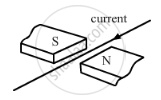
fron N to S
from S to N
vertically downwards
vertically upwards
Advertisements
उत्तर
vertically downwards
Using Fleming's left-hand rule, we find that the force on wire should act vertically downwards.
APPEARS IN
संबंधित प्रश्न
State Fleming’s left hand rule.
State whether the following statement is true or false:
The magnetic field inside a long circular coil carrying current well be parallel straight lines.
Describe how you will locate a current-carrying wire concealed in a wall.
Name and state the rule to determine the direction of magnetic field around a straight current-carrying conductor.
Name any two factors on which the strength of magnetic field produced by a current-carrying solenoid depends. How does it depend on these factors?
List three ways in which the magnetic field strength of a current-carrying solenoid can be increased?
A soft iron bar is inserted inside a current-carrying solenoid. The magnetic field inside the solenoid:
(a) will decrease
(b) will increase
(c) will become zero
(d) will remain the same
The front face of a circular wire carrying current behaves like a north pole. The direction of current in this face of circular wire is:
(a) clockwise
(b) downwards
(c) anticlockwise
(d) upwards
State two ways to increase the force on a current-carrying conductor in a magnetic field.
A horizontal wire carries a current as shown in Figure below between magnetic poles N and S:
Is the direction of the force on the wire due to the magnet:
(a) in the direction the current
(b) vertically downwards
(c) opposite to the current direction
(d) vertically upwards
i) Which principle is explained in this figure?
ii) Which rule is used to find out the direction of a force in this principle?
iii) In which machine this principle is used? Draw a diagram showing working of that machine

State two ways to increase the speed of rotation of a D.C. motor.
Differentiate between conductors and insulators.
State under what conditions force acting on a current carrying conductor which is freely suspended in a magnetic field can be Zero.
Describe the activity that shows that a current-carrying conductor experiences a force perpendicular to its length and the external magnetic field. How does Fleming’s left-hand rule help us to find the direction of the force acting on the current carrying conductor?
A simple motor is made in a school laboratory. A coil of wire is mounted on an axle between the poles of a horseshoe magnet, as illustrated.

In the example above, coil ABCD is horizontal and the battery is connected as shown.
- For this position, state the direction of the force on the arm AB.
- Why does the current in the arm BC not contribute to the turning force on the coil?
Assertion (A): A current carrying straight conductor experiences a force when placed perpendicular to the direction of magnetic field.
Reason (R): The net charge on a current carrying conductor is always zero.
