Advertisements
Advertisements
प्रश्न
State Fleming’s left hand rule.
Name and state the law used to find the direction of force on a current carrying conductor kept in a magnetic field.
Advertisements
उत्तर १
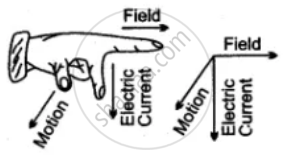
According to this rule, stretch the thumb, forefinger and middle finger of your left hand such that they are mutually perpendicular. If the first finger points in the direction of magnetic field and the second finger in the direction of the current, then the thumb will point in the direction of motion of the conductor or the force acting on the conductor.
उत्तर २
Stretch the forefinger, the middle finger, and the thumb of the right hand, such that they are mutually perpendicular to each other. If the forefinger indicates the direction of the magnetic field, the middle finger indicates the direction of current in the conductor, and the thumb indicates the direction of force exerted on the conductor.
APPEARS IN
संबंधित प्रश्न
State whether the following statement is true or false:
The magnetic field inside a long circular coil carrying current well be parallel straight lines.
State and explain the clock-face rule for determining the polarities of a circular wire carrying current.
What type of core should be put inside a current-carrying solenoid to make an electromagnet?
A soft iron bar is inserted inside a current-carrying solenoid. The magnetic field inside the solenoid:
(a) will decrease
(b) will increase
(c) will become zero
(d) will remain the same
A current-carrying conductor is held in exactly vertical direction. In order to produce a clockwise magnetic field around the conductor, the current should passed in the conductor:
(a) from top towards bottom
(b) from left towards right
(c) from bottom towards top
(d) from right towards left
A current-carrying conductor is placed perpendicularly in a magnetic field. Name the rule which can be used to find the direction of force acting on the conductor.
force experienced by a current-carrying straight conductor placed in a magnetic field which is perpendicular to it.
How will the direction of force be changed, if the current is reversed in the conductor placed in a magnetic field?
For a current in a long straight solenoid N- and S-poles are created at the two ends. Among the following statements, the incorrect statement is
Two LED bulbs of 10W and 5W are connected in series. If the current flowing through 5W bulb is 0.005A, the current flowing through 10W bulb is ______.
