Advertisements
Advertisements
प्रश्न
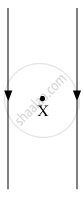
The following diagram shows two parallel straight conductors carrying the same current. Copy the diagram and draw the pattern of the magnetic field lines around them showing their directions. What is the magnitude of the magnetic field at a point 'X' which is equidistant from the conductors? Give justification for your answer.
Advertisements
उत्तर
Applying Right-hand thumb rule, we can draw the magnetic field lines around the given wires. As both the wires have a current flowing downward hence the direction of the magnetic field will be clockwise for both of them as shown in the figure:
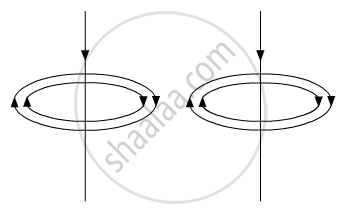
At point X, the magnetic field due to both conductors have opposite direction and as the point is equidistant from the conductors so due to symmetry the magnetic field the net magnitude of the magnetic field at point X is zero.
APPEARS IN
संबंधित प्रश्न
The magnetic field inside a long straight solenoid-carrying current ______.
Which of the following property of a proton can change while it moves freely in a magnetic field? (There may be more than one correct answer.)
State qualitatively the effect of inserting an iron core into a current-carrying solenoid.
The front face of a circular wire carrying current behaves like a north pole. The direction of current in this face of circular wire is:
(a) clockwise
(b) downwards
(c) anticlockwise
(d) upwards
For Fleming's left-hand rule, write down the three things that are 90° to each other, and next to each one write down the finger or thumb that represents it.
Which way does the wire in the diagram below tend to move?
State condition when magnitude of force on a current carrying conductor placed in a magnetic field is zero?
Name and state the law which is used to determine the direction of force on a current carrying conductor placed in a magnetic field.
State under what conditions force acting on a current carrying conductor which is freely suspended in a magnetic field can be Zero.
Which of the following factors affect the strength of force experience by current-carrying conduct in a uniform magnetic field?
