Advertisements
Advertisements
Questions
State Fleming’s left hand rule.
Name and state the law used to find the direction of force on a current carrying conductor kept in a magnetic field.
Advertisements
Solution 1
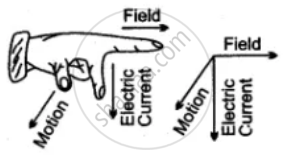
According to this rule, stretch the thumb, forefinger and middle finger of your left hand such that they are mutually perpendicular. If the first finger points in the direction of magnetic field and the second finger in the direction of the current, then the thumb will point in the direction of motion of the conductor or the force acting on the conductor.
Solution 2
Stretch the forefinger, the middle finger, and the thumb of the right hand, such that they are mutually perpendicular to each other. If the forefinger indicates the direction of the magnetic field, the middle finger indicates the direction of current in the conductor, and the thumb indicates the direction of force exerted on the conductor.
APPEARS IN
RELATED QUESTIONS
What are the various ways in which the strength of magnetic field produced by a current-carrying circular coil can be increased?
State and explain the clock-face rule for determining the polarities of a circular wire carrying current.
The magnetic field lines in the middle of the current-carrying solenoid are?
(a) circles
(b) spirals
(c) parallel to the axis of the tube
(d) perpendicular to the axis of the tube
The front face of a circular wire carrying current behaves like a north pole. The direction of current in this face of circular wire is:
(a) clockwise
(b) downwards
(c) anticlockwise
(d) upwards
Two coils A and B of insulated wire are kept close to each other. Coil A is connected to a galvanometer while coil B is connected to a battery through a key. What would happen if:
a current is passed through coil B by plugging the key?
Explain your answer mentioning the name of the phenomenon involved.
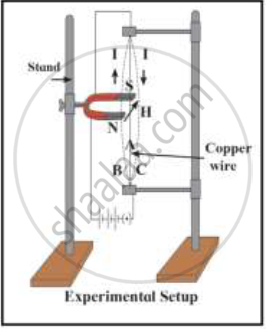
i) Which principle is explained in this figure?
ii) Which rule is used to find out the direction of a force in this principle?
iii) In which machine this principle is used? Draw a diagram showing working of that machine
State Fleming’s left-hand rule.
The shape of the magnetic field lines produced by a current-carrying conductor is ____________.
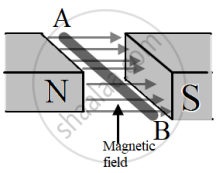
The diagram below shows a free conductor AB is kept in a magnetic field and is carrying current from A to B. (To avoid confusion complete path of the circuit is not shown) The direction of the force experienced by the conductor will be:
A simple motor is made in a school laboratory. A coil of wire is mounted on an axle between the poles of a horseshoe magnet, as illustrated.

In the example above, coil ABCD is horizontal and the battery is connected as shown.
- For this position, state the direction of the force on the arm AB.
- Why does the current in the arm BC not contribute to the turning force on the coil?
