Advertisements
Advertisements
Question
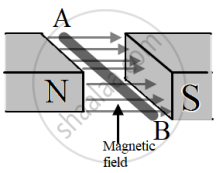
Observe the given figure of Fleming's Left Hand Rule and write the labels of 'A' and 'B':

Advertisements
Solution

APPEARS IN
RELATED QUESTIONS
A positively-charged particle (alpha-particle) projected towards west is deflected towards north by a magnetic field. The direction of magnetic field is ______.
Imagine that you are sitting in a chamber with your back to one wall. An electron beam, moving horizontally from back wall towards the front wall, is deflected by a strong magnetic field to your right side. What is the direction of magnetic field?
State Fleming’s left hand rule.
State qualitatively the effect of inserting an iron core into a current-carrying solenoid.
Fill in the following blank with suitable words:
For a current-carrying solenoid, the magnetic field is like that of a ...........
Draw a sketch to show the magnetic lines of force due to a current-carrying straight conductor.
Draw the magnetic lines of force due to a circular wire carrying current.
State and explain the clock-face rule for determining the polarities of a circular wire carrying current.
The diagram given below represents magnetic field caused by a current-carrying conductor which is:

(a) a long straight wire
(b) a circular coil
(c) a solenoid
(d) a short straight wire
The front face of a circular wire carrying current behaves like a north pole. The direction of current in this face of circular wire is:
(a) clockwise
(b) downwards
(c) anticlockwise
(d) upwards
A current-carrying straight wire is held in exactly vertical position. If the current passes through this wire in the vertically upward direction, what is the direction of magnetic field produced by it? Name the rule used to find the direction of magnetic field.
The magnetic field associated with a current-carrying straight conductor is in anticlockwise direction. If the conductor was held along the east-west direction, what will be the direction of current through it? Name and state the rule applied to determine the direction of current?
When is the force experienced by a current-carrying conductor placed in a magnetic field largest?
For Fleming's left-hand rule, write down the three things that are 90° to each other, and next to each one write down the finger or thumb that represents it.
A current-carrying conductor is placed perpendicularly in a magnetic field. Name the rule which can be used to find the direction of force acting on the conductor.
The force exerted on a current-carrying wire placed in a magnetic field is zero when the angle between the wire and the direction of magnetic field is:
45°
60°
90°
180°
A current flows in a wire running between the S and N poles of a magnet lying horizontally as shown in Figure below:
The force on the wire due to the magnet is directed:
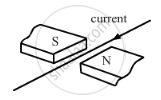
fron N to S
from S to N
vertically downwards
vertically upwards
A horizontal wire carries a current as shown in Figure below between magnetic poles N and S:
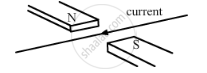
Is the direction of the force on the wire due to the magnet:
(a) in the direction the current
(b) vertically downwards
(c) opposite to the current direction
(d) vertically upwards
In the simple electric motor of figure given below, the coil rotates anticlockwise as seen by the eye from the position X when current flows in the coil
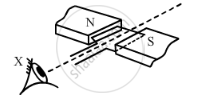
Is the current flowing clockwise or anticlockwise around the coil when viewed from above?
Name and state the law which is used to determine the direction of force on a current carrying conductor placed in a magnetic field.
A flat coil ABCD is freely suspended between the pole of U-shaped permanent magnet with the plane of coil parallel to the magnetic field.
What happens when a current is passed in the coil?
i) Which principle is explained in this figure?
ii) Which rule is used to find out the direction of a force in this principle?
iii) In which machine this principle is used? Draw a diagram showing working of that machine
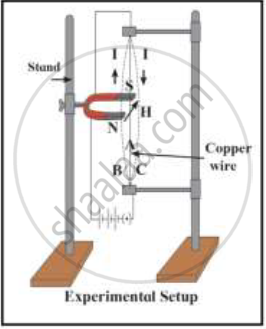
A flat coil ABCD is freely suspended between the pole of a U-shaped permanent magnet with the plane of coil parallel to the magnetic field.
When will coil come to rest?
A flat coil ABCD is freely suspended between the pole pieces of a U-shaped permanent magnet with the plane of coil parallel to the magnetic field.
When will the couple acting on the coil be
- maximum
- minimum?
The diagram below shows a free conductor AB is kept in a magnetic field and is carrying current from A to B. (To avoid confusion complete path of the circuit is not shown) The direction of the force experienced by the conductor will be:
For a current in a long straight solenoid N- and S-poles are created at the two ends. Among the following statements, the incorrect statement is
What does the direction of thumb indicate in the right-hand thumb rule. In what way this rule is different from Fleming’s left-hand rule?
A current-carrying conductor of a certain length, kept perpendicular to the magnetic field experiences a force F. What will be the force if the current is increased four times, the length is halved and the magnetic field is tripled?
A copper wire is held between the poles of a magnet
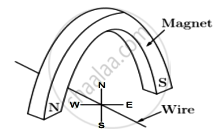
The current in the wire can be reversed. The pole of the magnet can also be changed over. In how many of the four directions shown can the force act on the wire?
An alpha particle enters a uniform magnetic field as shown. The direction of force experienced by the alpha particle is ______.

Assertion (A): A current carrying straight conductor experiences a force when placed perpendicular to the direction of magnetic field.
Reason (R): The net charge on a current carrying conductor is always zero.
Two LED bulbs of 10W and 5W are connected in series. If the current flowing through 5W bulb is 0.005A, the current flowing through 10W bulb is ______.
A copper conductor is placed over two stretched copper wires whose ends ate connected to a D.C. supply as shown in the diagram.
- What should be the magnetic poles at the points A and B lying on either side of the conductor to experience the force in the upward direction?
- Name the law used to find these polarities.

|
The graph (fig A) illustrates the correlation between the number of protons (x-axis) and the number of neutrons (y-axis) for elements A, B, C, D, and E in the periodic table. These elements are denoted by the letters rather than their conventional symbols. When the element C, depicted in the graph, undergoes radioactive decay, it releases radioactive rays. When these rays are directed into the plane of the paper in the presence of a magnetic field, as indicated in the fig B, they experience deflection, causing them to move upwards.
|
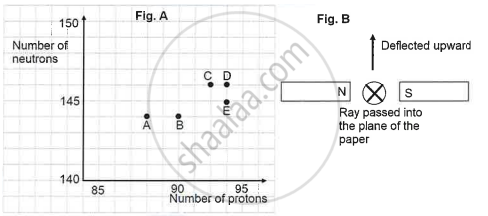
Name the law used to identify the radioactive radiation emitted by the element.
