Advertisements
Advertisements
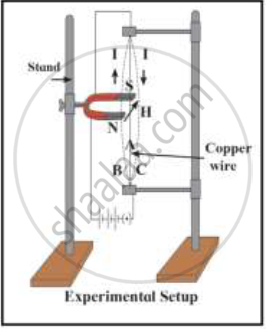
Question
i) Which principle is explained in this figure?
ii) Which rule is used to find out the direction of a force in this principle?
iii) In which machine this principle is used? Draw a diagram showing working of that machine
Advertisements
Solution
i. A force is exerted on the current-carrying conductor in the presence of a magnetic field.
ii. The Fleming’s Left-hand Rule is used.
iii. Electric Motor
APPEARS IN
RELATED QUESTIONS
The magnetic field in a given region is uniform. Draw a diagram to represent it.
A positively-charged particle (alpha-particle) projected towards west is deflected towards north by a magnetic field. The direction of magnetic field is ______.
Which of the following correctly describes the magnetic field near a long straight wire?
State whether the following statement is true or false
The field at the centre of a long circular coil carrying current will be parallel straight lines.
When is the force experienced by a current-carrying conductor placed in a magnetic field largest?
Imagine that you are sitting in a chamber with your back to one wall. An electron beam, moving horizontally from back wall towards the front wall, is deflected by a strong magnetic field to your right side. What is the direction of magnetic field?
State qualitatively the effect of inserting an iron core into a current-carrying solenoid.
Fill in the following blank with suitable words:
For a current-carrying solenoid, the magnetic field is like that of a ...........
Name and state the rule to determine the direction of magnetic field around a straight current-carrying conductor.
Draw the magnetic lines of force due to a circular wire carrying current.
What are the various ways in which the strength of magnetic field produced by a current-carrying circular coil can be increased?
Name any two factors on which the strength of magnetic field produced by a current-carrying solenoid depends. How does it depend on these factors?
What is a solenoid?
List three ways in which the magnetic field strength of a current-carrying solenoid can be increased?
What type of core should be put inside a current-carrying solenoid to make an electromagnet?
The front face of a circular wire carrying current behaves like a north pole. The direction of current in this face of circular wire is:
(a) clockwise
(b) downwards
(c) anticlockwise
(d) upwards
A current-carrying straight wire is held in exactly vertical position. If the current passes through this wire in the vertically upward direction, what is the direction of magnetic field produced by it? Name the rule used to find the direction of magnetic field.
The magnetic field associated with a current-carrying straight conductor is in anticlockwise direction. If the conductor was held along the east-west direction, what will be the direction of current through it? Name and state the rule applied to determine the direction of current?
In a statement of Fleming's left-hand rule, what do the following represent?
(a) direction of centre finger.
(b) direction of forefinger.
(c) direction of thumb.
For Fleming's left-hand rule, write down the three things that are 90° to each other, and next to each one write down the finger or thumb that represents it.
A current-carrying conductor is placed perpendicularly in a magnetic field. Name the rule which can be used to find the direction of force acting on the conductor.
In the simple electric motor of figure given below, the coil rotates anticlockwise as seen by the eye from the position X when current flows in the coil
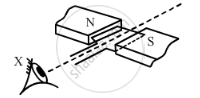
Is the current flowing clockwise or anticlockwise around the coil when viewed from above?
If the current in a wire is flowing in the vertically downward direction and a magnetic field is applied from west to east, what is the direction of force in the wire?
What is the force on a current-carrying wire that is parallel to a magnetic field? Give reason for your answer.
force experienced by a current-carrying straight conductor placed in a magnetic field which is perpendicular to it.
Name three factors on which the magnitude of force on a current carrying conductor placed in a magnetic field depends and state how does the force depend on the factors stated by you.
How will the direction of force be changed, if the current is reversed in the conductor placed in a magnetic field?
State the unit of magnetic field in terms of the force experienced by a current carrying conductor placed in a magnetic field
State Fleming’s left-hand rule.
A flat coil ABCD is freely suspended between the pole of a U-shaped permanent magnet with the plane of coil parallel to the magnetic field.
When will coil come to rest?
A flat coil ABCD is freely suspended between the pole pieces of a U-shaped permanent magnet with the plane of coil parallel to the magnetic field.
When will the couple acting on the coil be
- maximum
- minimum?
State whether a magnetic field is associated or not around a static charge.
A current flows in a wire running between the S and N poles of a magnet lying horizontally as shown in the figure below:

The force on the wire due to the magnet is directed ____________.
The strength of magnetic field around a current-carrying conductor is ____________.
A magnetic field directed in north direction acts on an electron moving in east direction. The magnetic force on the electron will act ____________.
For a current in a long straight solenoid N- and S-poles are created at the two ends. Among the following statements, the incorrect statement is
What does the direction of thumb indicate in the right-hand thumb rule. In what way this rule is different from Fleming’s left-hand rule?
A current-carrying conductor of a certain length, kept perpendicular to the magnetic field experiences a force F. What will be the force if the current is increased four times, the length is halved and the magnetic field is tripled?
