Advertisements
Advertisements
Question
A copper conductor is placed over two stretched copper wires whose ends ate connected to a D.C. supply as shown in the diagram.
- What should be the magnetic poles at the points A and B lying on either side of the conductor to experience the force in the upward direction?
- Name the law used to find these polarities.

Advertisements
Solution
- A - North pole
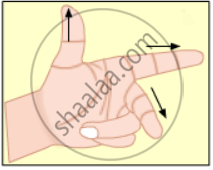
B - South pole - The Fleming's left hand rule is the law that was applied to ascertain the polarities.
APPEARS IN
RELATED QUESTIONS
Which of the following correctly describes the magnetic field near a long straight wire?
What concealed do you get from the observation that a current-carrying wire deflects a compass needle placed near it?
What is the shape of a current-carrying conductor whose magnetic field pattern resembles that of a bar magnet?
What is the shape of field lines inside a current-carrying solenoid? What does the pattern of field lines inside a current-carrying solenoid indicate?
What type of core should be put inside a current-carrying solenoid to make an electromagnet?
force experienced by a current-carrying straight conductor placed in a magnetic field which is perpendicular to it.
State condition when magnitude of force on a current carrying conductor placed in a magnetic field is maximum?
Name the following diagram and explain the concept behind it.
The strength of magnetic field around a current-carrying conductor is ____________.
A copper wire is held between the poles of a magnet
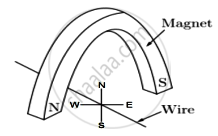
The current in the wire can be reversed. The pole of the magnet can also be changed over. In how many of the four directions shown can the force act on the wire?
