Advertisements
Advertisements
प्रश्न
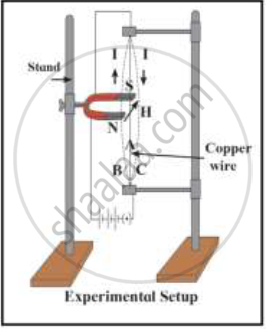
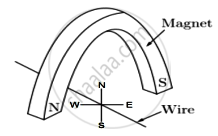
i) Which principle is explained in this figure?
ii) Which rule is used to find out the direction of a force in this principle?
iii) In which machine this principle is used? Draw a diagram showing working of that machine
Advertisements
उत्तर
i. A force is exerted on the current-carrying conductor in the presence of a magnetic field.
ii. The Fleming’s Left-hand Rule is used.
iii. Electric Motor
APPEARS IN
संबंधित प्रश्न
The magnetic field inside a long straight solenoid-carrying current ______.
State Fleming’s left hand rule.
Observe the following figure:

If the current in the coil A is changed, will some current be induced in the coil B? Explain.
Name the rule for finding the direction of magnetic field produced by a straight current-carrying conductor.
State whether the following statement is true or false:
The magnetic field inside a long circular coil carrying current well be parallel straight lines.
What is the shape of a current-carrying conductor whose magnetic field pattern resembles that of a bar magnet?
Describe how you will locate a current-carrying wire concealed in a wall.
Draw the magnetic lines of force due to a circular wire carrying current.
Name the type of magnet with which the magnetic field pattern of a current-carrying solenoid resembles.
What is the shape of field lines inside a current-carrying solenoid? What does the pattern of field lines inside a current-carrying solenoid indicate?
The diagram given below represents magnetic field caused by a current-carrying conductor which is:

(a) a long straight wire
(b) a circular coil
(c) a solenoid
(d) a short straight wire
The magnetic field lines in the middle of the current-carrying solenoid are?
(a) circles
(b) spirals
(c) parallel to the axis of the tube
(d) perpendicular to the axis of the tube
When is the force experienced by a current-carrying conductor placed in a magnetic field largest?
A current-carrying conductor is placed perpendicularly in a magnetic field. Name the rule which can be used to find the direction of force acting on the conductor.
State Fleming's left-hand rule. Explain it with the help of labelled diagrams.
The force experienced by a current-carrying conductor placed in a magnetic field is the largest when the angle between the conductor and the magnetic field is:
45°
60°
90°
180°
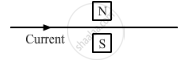
Which way does the wire in the diagram below tend to move?
State condition when magnitude of force on a current carrying conductor placed in a magnetic field is maximum?
How will the direction of force be changed, if the current is reversed in the conductor placed in a magnetic field?
Name the following diagram and explain the concept behind it.
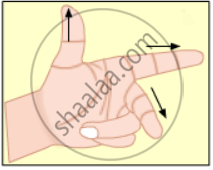
Name and state the rule of determine the direction of force experienced by a current carrying straight conductor placed in a uniform magnetic field which is perpendicular to it.
Differentiate between conductors and insulators.
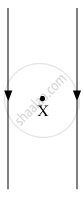
The following diagram shows two parallel straight conductors carrying the same current. Copy the diagram and draw the pattern of the magnetic field lines around them showing their directions. What is the magnitude of the magnetic field at a point 'X' which is equidistant from the conductors? Give justification for your answer.
State under what conditions force acting on a current carrying conductor which is freely suspended in a magnetic field can be Zero.
Write Fleming’s left hand rule.
A current-carrying conductor is held in an exactly vertical direction. In order to produce a clockwise magnetic field around the conductor, the current should be passed in the conductor:
A current flows in a wire running between the S and N poles of a magnet lying horizontally as shown in the figure below:

The force on the wire due to the magnet is directed ____________.
The strength of magnetic field around a current-carrying conductor is ____________.
A magnetic field directed in north direction acts on an electron moving in east direction. The magnetic force on the electron will act ____________.
The direction of force on a current carrying conductor in a magnetic field is given by ____________.
What does the direction of thumb indicate in the right-hand thumb rule. In what way this rule is different from Fleming’s left-hand rule?
Describe the activity that shows that a current-carrying conductor experiences a force perpendicular to its length and the external magnetic field. How does Fleming’s left-hand rule help us to find the direction of the force acting on the current carrying conductor?
What do you know about Michael Faraday?
A current-carrying conductor of a certain length, kept perpendicular to the magnetic field experiences a force F. What will be the force if the current is increased four times, the length is halved and the magnetic field is tripled?
A copper wire is held between the poles of a magnet
The current in the wire can be reversed. The pole of the magnet can also be changed over. In how many of the four directions shown can the force act on the wire?
If the strength of the current flowing through a wire is increased, the strength of the magnetic field produced by it ______.
