Advertisements
Advertisements
प्रश्न
State the unit of magnetic field in terms of the force experienced by a current carrying conductor placed in a magnetic field
Advertisements
उत्तर
Newton/ampere × meter (or NA-1m-1).
APPEARS IN
संबंधित प्रश्न
Which of the following property of a proton can change while it moves freely in a magnetic field? (There may be more than one correct answer.)
State whether the following statement is true or false:
The magnetic field inside a long circular coil carrying current well be parallel straight lines.
What are the various ways in which the strength of magnetic field produced by a current-carrying circular coil can be increased?
What type of core should be put inside a current-carrying solenoid to make an electromagnet?
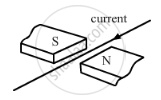
A current flows in a wire running between the S and N poles of a magnet lying horizontally as shown in Figure below:
The force on the wire due to the magnet is directed:
fron N to S
from S to N
vertically downwards
vertically upwards
A horizontal wire carries a current as shown in Figure below between magnetic poles N and S:
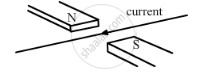
Is the direction of the force on the wire due to the magnet:
(a) in the direction the current
(b) vertically downwards
(c) opposite to the current direction
(d) vertically upwards
What is the force on a current-carrying wire that is parallel to a magnetic field? Give reason for your answer.
State whether a magnetic field is associated or not around a static charge.
The strength of magnetic field around a current-carrying conductor is ____________.
An alpha particle enters a uniform magnetic field as shown. The direction of force experienced by the alpha particle is ______.

