हिंदी

A Horizontal Wire Carries a Current as Shown in Figure Below Between Magnetic Poles N and S:

Advertisements
Advertisements

प्रश्न

A horizontal wire carries a current as shown in Figure below between magnetic poles N and S: 
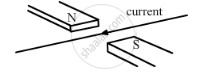
  

Is the direction of the force on the wire due to the magnet:

(a) in the direction the current
(b) vertically downwards
(c) opposite to the current direction
(d) vertically upwards 

Advertisements

उत्तर

vertically upwards
Applying Fleming's left-hand rule, we find that the force on the wire will act vertically upward.

shaalaa.com
  क्या इस प्रश्न या उत्तर में कोई त्रुटि है?
अध्याय 5: Magnetic Effects of Electric Current - Exercise 3 [पृष्ठ ९३]

APPEARS IN

लखमीर सिंग Physics [English] Class 10
अध्याय 5 Magnetic Effects of Electric Current
Exercise 3 | Q 30 | पृष्ठ ९३

संबंधित प्रश्न

Which of the following property of a proton can change while it moves freely in a magnetic field? (There may be more than one correct answer.)


State the rule to determine the direction of a force experienced by a current-carrying straight conductor placed in a magnetic field which is perpendicular to it.


Name and state the rule to determine the direction of magnetic field around a straight current-carrying conductor.


What is a solenoid? Draw a sketch to show the magnetic field pattern produced by a current-carrying solenoid.


 List three ways in which the magnetic field strength of a current-carrying solenoid can be increased?


A current-carrying straight wire is held in exactly vertical position. If the current passes through this wire in the vertically upward direction, what is the direction of magnetic field produced by it? Name the rule used to find the direction of magnetic field. 


The magnetic field associated with a current-carrying straight conductor is in anticlockwise direction. If the conductor was held along the east-west direction, what will be the direction of current through it? Name and state the rule applied to determine the direction of current?


For Fleming's left-hand rule, write down the three things that are 90° to each other, and next to each one write down the finger or thumb that represents it.


State Fleming's left-hand rule. Explain it with the help of labelled diagrams.


The force exerted on a current-carrying wire placed in a magnetic field is zero when the angle between the wire and the direction of magnetic field is: 

 45°
 60°
 90°
 180°


 force experienced by a current-carrying straight conductor placed in a magnetic field which is perpendicular to it. 


State condition when magnitude of force on a current carrying conductor placed in a magnetic field is zero?


A flat coil ABCD is freely suspended between the pole of U-shaped permanent magnet with the plane of coil parallel to the magnetic field.

What happens when a current is passed in the coil?


Name and state the rule of determine the direction of force experienced by a current carrying straight conductor placed in a uniform magnetic field which is perpendicular to it. 


A flat coil ABCD is freely suspended between the pole of a U-shaped permanent magnet with the plane of coil parallel to the magnetic field.

Name an instrument which makes use of the principle stated above.


A current flows in a wire running between the S and N poles of a magnet lying horizontally as shown in the figure below:

The force on the wire due to the magnet is directed ____________.


A current-carrying conductor of a certain length, kept perpendicular to the magnetic field experiences a force F. What will be the force if the current is increased four times, the length is halved and the magnetic field is tripled?


Two LED bulbs of 10W and 5W are connected in series. If the current flowing through 5W bulb is 0.005A, the current flowing through 10W bulb is ______.


Share
Notifications

Englishहिंदीमराठी


      Forgot password?
Use app×