Advertisements
Advertisements
प्रश्न
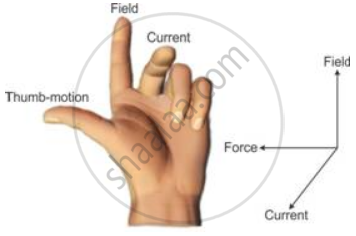
State Fleming’s left-hand rule.
Advertisements
उत्तर
Stretch the forefinger, middle finger, and the thumb of your left hand mutually perpendicular to each other. If the forefinger indicates the direction of the magnetic field and the middle finger indicates the direction of the current, then the thumb will indicate the direction of motion of the conductor.
APPEARS IN
संबंधित प्रश्न
Observe the following figure:

If the current in the coil A is changed, will some current be induced in the coil B? Explain.
The magnetic field lines in the middle of the current-carrying solenoid are?
(a) circles
(b) spirals
(c) parallel to the axis of the tube
(d) perpendicular to the axis of the tube
The force exerted on a current-carrying wire placed in a magnetic field is zero when the angle between the wire and the direction of magnetic field is:
45°
60°
90°
180°
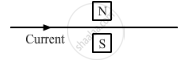
Which way does the wire in the diagram below tend to move?
Name and state the law which is used to determine the direction of force on a current carrying conductor placed in a magnetic field.
Differentiate between conductors and insulators.
State whether a magnetic field is associated or not around a moving charge.
Which of the following factors affect the strength of force experience by current-carrying conduct in a uniform magnetic field?
The diagram below shows a free conductor AB is kept in a magnetic field and is carrying current from A to B. (To avoid confusion complete path of the circuit is not shown) The direction of the force experienced by the conductor will be:
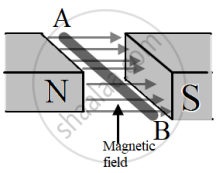
A copper conductor is placed over two stretched copper wires whose ends ate connected to a D.C. supply as shown in the diagram.
- What should be the magnetic poles at the points A and B lying on either side of the conductor to experience the force in the upward direction?
- Name the law used to find these polarities.

