Advertisements
Advertisements
प्रश्न
The diagram below shows a free conductor AB is kept in a magnetic field and is carrying current from A to B. (To avoid confusion complete path of the circuit is not shown) The direction of the force experienced by the conductor will be:
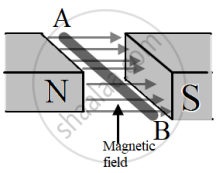
विकल्प
Up
Down
Towards N
Towards S
Advertisements
उत्तर
Up
APPEARS IN
संबंधित प्रश्न
Observe the following figure:

If the current in the coil A is changed, will some current be induced in the coil B? Explain.
Name the rule for finding the direction of magnetic field produced by a straight current-carrying conductor.
Draw a sketch to show the magnetic lines of force due to a current-carrying straight conductor.
A current-carrying conductor is held in exactly vertical direction. In order to produce a clockwise magnetic field around the conductor, the current should passed in the conductor:
(a) from top towards bottom
(b) from left towards right
(c) from bottom towards top
(d) from right towards left
Name one device whose working depends on the force exerted on a current-carrying coil placed in a magnetic field.
The force experienced by a current-carrying conductor placed in a magnetic field is the largest when the angle between the conductor and the magnetic field is:
45°
60°
90°
180°
A current flows in a wire running between the S and N poles of a magnet lying horizontally as shown in Figure below:
The force on the wire due to the magnet is directed:
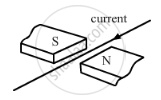
fron N to S
from S to N
vertically downwards
vertically upwards
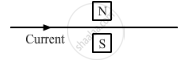
Which way does the wire in the diagram below tend to move?
A current-carrying conductor of a certain length, kept perpendicular to the magnetic field experiences a force F. What will be the force if the current is increased four times, the length is halved and the magnetic field is tripled?
