Advertisements
Advertisements
प्रश्न
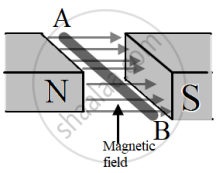
The diagram below shows a free conductor AB is kept in a magnetic field and is carrying current from A to B. (To avoid confusion complete path of the circuit is not shown) The direction of the force experienced by the conductor will be:
पर्याय
Up
Down
Towards N
Towards S
Advertisements
उत्तर
Up
APPEARS IN
संबंधित प्रश्न
State Fleming’s left hand rule.
Draw the magnetic lines of force due to a circular wire carrying current.
State and explain the clock-face rule for determining the polarities of a circular wire carrying current.
A soft iron bar is inserted inside a current-carrying solenoid. The magnetic field inside the solenoid:
(a) will decrease
(b) will increase
(c) will become zero
(d) will remain the same
The force experienced by a current-carrying conductor placed in a magnetic field is the largest when the angle between the conductor and the magnetic field is:
45°
60°
90°
180°
The force exerted on a current-carrying wire placed in a magnetic field is zero when the angle between the wire and the direction of magnetic field is:
45°
60°
90°
180°
In the simple electric motor of figure given below, the coil rotates anticlockwise as seen by the eye from the position X when current flows in the coil
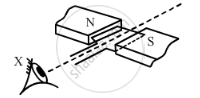
Is the current flowing clockwise or anticlockwise around the coil when viewed from above?
State condition when magnitude of force on a current carrying conductor placed in a magnetic field is zero?
What does the direction of thumb indicate in the right-hand thumb rule. In what way this rule is different from Fleming’s left-hand rule?
If the strength of the current flowing through a wire is increased, the strength of the magnetic field produced by it ______.
