Advertisements
Advertisements
Question
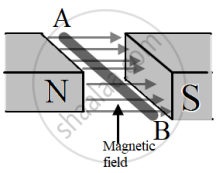
The diagram below shows a free conductor AB is kept in a magnetic field and is carrying current from A to B. (To avoid confusion complete path of the circuit is not shown) The direction of the force experienced by the conductor will be:
Options
Up
Down
Towards N
Towards S
Advertisements
Solution
Up
APPEARS IN
RELATED QUESTIONS
State whether the following statement is true or false:
The magnetic field inside a long circular coil carrying current well be parallel straight lines.
What are the various ways in which the strength of magnetic field produced by a current-carrying circular coil can be increased?
State two ways to increase the force on a current-carrying conductor in a magnetic held.
Two coils A and B of insulated wire are kept close to each other. Coil A is connected to a galvanometer while coil B is connected to a battery through a key. What would happen if:
a current is passed through coil B by plugging the key?
Explain your answer mentioning the name of the phenomenon involved.
Name three factors on which the magnitude of force on a current carrying conductor placed in a magnetic field depends and state how does the force depend on the factors stated by you.
Name and state the rule of determine the direction of force experienced by a current carrying straight conductor placed in a uniform magnetic field which is perpendicular to it.
A magnetic field directed in north direction acts on an electron moving in east direction. The magnetic force on the electron will act ____________.
For a current in a long straight solenoid N- and S-poles are created at the two ends. Among the following statements, the incorrect statement is
What does the direction of thumb indicate in the right-hand thumb rule. In what way this rule is different from Fleming’s left-hand rule?
