Advertisements
Advertisements
Question
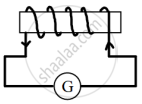
The diagram below shows a magnet moved near a coil along its axis. Which of the diagram shows correct flow of current during this motion?
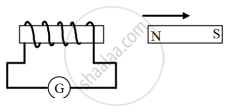
Options
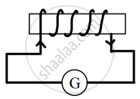
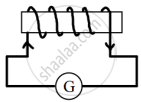
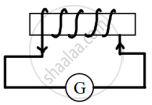
Advertisements
Solution
APPEARS IN
RELATED QUESTIONS
Draw a diagram to represent the magnetic field lines along the axis of a current carrying solenoid. Mark arrows to show the direction of current in the solenoid and the direction of magnetic field lines.
Derive the expression for the heat produced due to a current ‘I’ flowing for a time interval ‘t’ through a resistor ‘R’ having a potential difference ‘V’ across its ends. With which name is the relation known? How much heat will an instrument of 12W produce in one minute if it is connected to a battery of 12V?
Draw magnetic field lines in and around a current-carrying straight solenoid.
Sketch the lines of force of the magnetic field of a solenoid. How does its field compare with that of a bar magnet?
The factors on which one magnetic field strength is produced by current-carrying solenoids depends are
What does the divergence of magnetic field lines near the ends of a current carrying straight solenoid indicate?
Ansari Sir was demonstrating an experiment in his class with the setup as shown in the figure below.

A magnet is attached to a spring. The magnet can go in and out of the stationary coil. He lifted the Magnet and released it to make it oscillate through the coil.
Based on your understanding of the phenomenon, answer the following question.
Is there any difference in the observations in the galvanometer when the Magnet swings in and then out of the stationary coil? Justify your answer.
When does a solenoid behave as a magnet? Draw the pattern of the magnetic field produced inside it showing the directions of the magnetic field lines.
For the current carrying solenoid as shown, draw magnetic field lines and give reason to explain that out of the three points A, B and C, at which point the field strength is maximum and at which point it is minimum?

How is a solenoid prepared?
