Advertisements
Advertisements
Questions
Draw a diagram to represent the magnetic field lines along the axis of a current carrying solenoid. Mark arrows to show the direction of current in the solenoid and the direction of magnetic field lines.
Draw a diagram, showing the magnetic field lines in and around the current carrying solenoid.
Advertisements
Solution
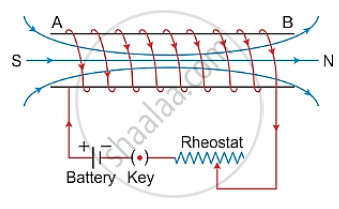
Along the axis of a current-carrying solenoid, the lines of magnetic fields are nearly parallel to one another.
RELATED QUESTIONS
Why does a current carrying, freely suspended solenoid rest along a particular direction?
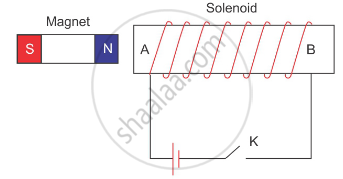
The adjacent diagram shows a small magnet placed near a solenoid AB. Current is switched on in the solenoid by pressing the key K.
- State the polarity at the ends A and B.
- Will the magnet be attracted or repelled? Give a reason for your answer.
The following diagram shows a spiral coil wound on a hollow carboard tube AB. A magnetic compass is placed close to it. Current is switched on by closing the key.
- What will be the polarity at the ends A and B?
- How will the compass needle be affected? Give reason.

How is the magnetic field due to a solenoid carrying current affected if a soft iron bar is introduced inside the solenoid?
A current carrying solenoid when freely suspended, it always rests in ______ direction.
Draw the pattern of magnetic field lines of a solenoid through which a steady current flows. What does the pattern of field lines inside the solenoid indicate?
Which of the following diagrams correctly shows the magnetic field produced by a current-carrying wire?
The pattern of the magnetic field produced by the straight current-carrying conducting wire is ____________.
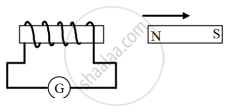
The diagram below shows a magnet moved near a coil along its axis. Which of the diagram shows correct flow of current during this motion?
How is a solenoid prepared?
