Advertisements
Advertisements
Question
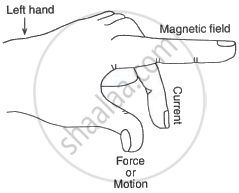
State Fleming’s left-hand rule.
Advertisements
Solution
Hold the forefinger, the centre finger and the thumb of your left hand at right angles to one another. Adjust your hand in such a way that the forefinger points in the direction of the magnetic field and the centre finger points in the direction of the current in the conductor; then the direction in which the thumb points gives the direction of motion of the conductor.
RELATED QUESTIONS
Which of the following property of a proton can change while it moves freely in a magnetic field? (There may be more than one correct answer.)
Which of the following property of a proton can change while it moves freely in a magnetic field? (There may be more than one correct answer.)
Name the type of magnet with which the magnetic field pattern of a current-carrying solenoid resembles.
A horizontal wire carries a current as shown in Figure below between magnetic poles N and S:
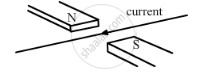
Is the direction of the force on the wire due to the magnet:
(a) in the direction the current
(b) vertically downwards
(c) opposite to the current direction
(d) vertically upwards
A flat coil ABCD is freely suspended between the pole of U-shaped permanent magnet with the plane of coil parallel to the magnetic field.
What happens when a current is passed in the coil?
State two ways to increase the speed of rotation of a D.C. motor.
A current-carrying conductor is held in an exactly vertical direction. In order to produce a clockwise magnetic field around the conductor, the current should be passed in the conductor:
A magnetic field directed in north direction acts on an electron moving in east direction. The magnetic force on the electron will act ____________.
The direction of force on a current carrying conductor in a magnetic field is given by ____________.
Describe the activity that shows that a current-carrying conductor experiences a force perpendicular to its length and the external magnetic field. How does Fleming’s left-hand rule help us to find the direction of the force acting on the current carrying conductor?
