Advertisements
Advertisements
प्रश्न
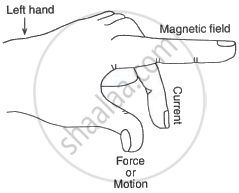
State Fleming’s left-hand rule.
Advertisements
उत्तर
Hold the forefinger, the centre finger and the thumb of your left hand at right angles to one another. Adjust your hand in such a way that the forefinger points in the direction of the magnetic field and the centre finger points in the direction of the current in the conductor; then the direction in which the thumb points gives the direction of motion of the conductor.
संबंधित प्रश्न
State Fleming’s left hand rule.
Name the rule for finding the direction of magnetic field produced by a straight current-carrying conductor.
Draw the magnetic lines of force due to a circular wire carrying current.
What is the force on a current-carrying wire that is parallel to a magnetic field? Give reason for your answer.
Name three factors on which the magnitude of force on a current carrying conductor placed in a magnetic field depends and state how does the force depend on the factors stated by you.
State the unit of magnetic field in terms of the force experienced by a current carrying conductor placed in a magnetic field
A flat coil ABCD is freely suspended between the pole of a U-shaped permanent magnet with the plane of coil parallel to the magnetic field.
Name an instrument which makes use of the principle stated above.
A current flows in a wire running between the S and N poles of a magnet lying horizontally as shown in the figure below:

The force on the wire due to the magnet is directed ____________.
Which of the following pattern correctly describes the magnetic field around a long straight wire carrying current?
A copper conductor is placed over two stretched copper wires whose ends ate connected to a D.C. supply as shown in the diagram.
- What should be the magnetic poles at the points A and B lying on either side of the conductor to experience the force in the upward direction?
- Name the law used to find these polarities.

