मराठी

State Fleming’S Left-hand Rule. - Science

Advertisements
Advertisements

प्रश्न

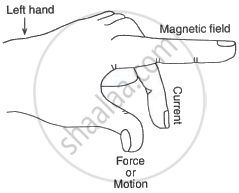
State Fleming’s left-hand rule.

Advertisements

उत्तर

Fleming’s left hand rule states that if we arrange the thumb, the centre finger, and the forefinger of the left hand at right angles to each other, then the thumb points towards the direction of the magnetic force, the centre finger gives the direction of current, and the forefinger points in the direction of magnetic field.

shaalaa.com
  या प्रश्नात किंवा उत्तरात काही त्रुटी आहे का?
पाठ 13: Magnetic Effects of Electric Current - Intext Questions [पृष्ठ २३३]

APPEARS IN

एनसीईआरटी Science [English] Class 10
पाठ 13 Magnetic Effects of Electric Current
Intext Questions | Q 1 | पृष्ठ २३३

संबंधित प्रश्‍न

Which of the following property of a proton can change while it moves freely in a magnetic field? (There may be more than one correct answer.)


State whether the following statement is true or false

The field at the centre of a long circular coil carrying current will be parallel straight lines.


Imagine that you are sitting in a chamber with your back to one wall. An electron beam, moving horizontally from back wall towards the front wall, is deflected by a strong magnetic field to your right side. What is the direction of magnetic field?


Name the rule for finding the direction of magnetic field produced by a straight current-carrying conductor.


Fill in the following blank with suitable words: 

For a current-carrying solenoid, the magnetic field is like that of a ...........


The diagram given below represents magnetic field caused by a current-carrying conductor which is: 

 

(a) a long straight wire
(b) a circular coil
(c) a solenoid
(d) a short straight wire 


A soft iron bar is inserted inside a current-carrying solenoid. The magnetic field inside the solenoid:

(a) will decrease
(b) will increase
(c) will become zero
(d) will remain the same


The front face of a circular wire carrying current behaves like a north pole. The direction of current in this face of circular wire is:

(a) clockwise
(b) downwards
(c) anticlockwise
(d) upwards


A current-carrying straight wire is held in exactly vertical position. If the current passes through this wire in the vertically upward direction, what is the direction of magnetic field produced by it? Name the rule used to find the direction of magnetic field. 


In a statement of Fleming's left-hand rule, what do the following represent?

(a) direction of centre finger.
(b) direction of forefinger.
(c) direction of thumb.


 A current-carrying conductor is placed perpendicularly in a magnetic field. Name the rule which can be used to find the direction of force acting on the conductor.


A horizontal wire carries a current as shown in Figure below between magnetic poles N and S: 


Is the direction of the force on the wire due to the magnet:

(a) in the direction the current
(b) vertically downwards
(c) opposite to the current direction
(d) vertically upwards 


What is the force on a current-carrying wire that is parallel to a magnetic field? Give reason for your answer. 


Name three factors on which the magnitude of force on a current carrying conductor placed in a magnetic field depends and state how does the force depend on the factors stated by you.


State condition when magnitude of force on a current carrying conductor placed in a magnetic field is maximum?


Name the following diagram and explain the concept behind it.


What does the direction of thumb indicate in the right-hand thumb rule. In what way this rule is different from Fleming’s left-hand rule?


A current-carrying conductor of a certain length, kept perpendicular to the magnetic field experiences a force F. What will be the force if the current is increased four times, the length is halved and the magnetic field is tripled?


The graph (fig A) illustrates the correlation between the number of protons (x-axis) and the number of neutrons (y-axis) for elements A, B, C, D, and E in the periodic table. These elements are denoted by the letters rather than their conventional symbols. When the element C, depicted in the graph, undergoes radioactive decay, it releases radioactive rays. When these rays are directed into the plane of the paper in the presence of a magnetic field, as indicated in the fig B, they experience deflection, causing them to move upwards.

Name the law used to identify the radioactive radiation emitted by the element.


Share
Notifications

Englishहिंदीमराठी


      Forgot password?
Use app×