मराठी

Draw a Sketch to Show the Magnetic Lines of Force Due to a Current-carrying Straight Conductor. - Science

Advertisements
Advertisements

प्रश्न

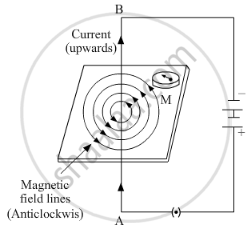
Draw a sketch to show the magnetic lines of force due to a current-carrying straight conductor.

Advertisements

उत्तर

The magnetic field lines due to a current-carrying straight conductor are concentric circles whose centres lie on the wire. 


shaalaa.com
  या प्रश्नात किंवा उत्तरात काही त्रुटी आहे का?
पाठ 2: Magnetic Effects of Electric Current - Exercise 2 [पृष्ठ ८२]

APPEARS IN

लखमीर सिंह Physics (Science) [English] Class 10
पाठ 2 Magnetic Effects of Electric Current
Exercise 2 | Q 14.1 | पृष्ठ ८२

संबंधित प्रश्‍न

The magnetic field inside a long straight solenoid-carrying current ______.


Which of the following property of a proton can change while it moves freely in a magnetic field? (There may be more than one correct answer.)


State Fleming’s left-hand rule.


Which of the following correctly describes the magnetic field near a long straight wire?


Observe the following figure:

If the current in the coil A is changed, will some current be induced in the coil B? Explain.


State whether the following statement is true or false:
The magnetic field inside a long circular coil carrying current well be parallel straight lines.


What is a solenoid? Draw a sketch to show the magnetic field pattern produced by a current-carrying solenoid.


 List three ways in which the magnetic field strength of a current-carrying solenoid can be increased?


The diagram given below represents magnetic field caused by a current-carrying conductor which is: 


(a) a long straight wire
(b) a circular coil
(c) a solenoid
(d) a short straight wire 


In the simple electric motor of figure given below, the coil rotates anticlockwise as seen by the eye from the position X when current flows in the coil  


Is the current flowing clockwise or anticlockwise around the coil when viewed from above? 


 force experienced by a current-carrying straight conductor placed in a magnetic field which is perpendicular to it. 


Two coils A and B of insulated wire are kept close to each other. Coil A is connected to a galvanometer while coil B is connected to a battery through a key. What would happen if: 

a current is passed through coil B by plugging the key?  

Explain your answer mentioning the name of the phenomenon involved.


i) Which principle is explained in this figure?
ii) Which rule is used to find out the direction of a force in this principle?
iii) In which machine this principle is used? Draw a diagram showing working of that machine


State Fleming’s left-hand rule.


State under what conditions force acting on a current carrying conductor which is freely suspended in a magnetic field can be Zero.


When current is parallel to a magnetic field, then force experience by the current-carrying conductor placed in a uniform magnetic field is ____________.


What does the direction of thumb indicate in the right-hand thumb rule. In what way this rule is different from Fleming’s left-hand rule?


A simple motor is made in a school laboratory. A coil of wire is mounted on an axle between the poles of a horseshoe magnet, as illustrated.

In the example above, coil ABCD is horizontal and the battery is connected as shown.

  1. For this position, state the direction of the force on the arm AB.
  2. Why does the current in the arm BC not contribute to the turning force on the coil?

What do you know about Michael Faraday?


Two LED bulbs of 10W and 5W are connected in series. If the current flowing through 5W bulb is 0.005A, the current flowing through 10W bulb is ______.


Share
Notifications

Englishहिंदीमराठी


      Forgot password?
Use app×