Advertisements
Advertisements
Question
|
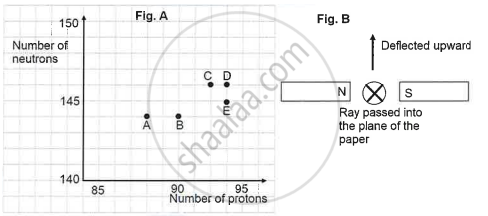
The graph (fig A) illustrates the correlation between the number of protons (x-axis) and the number of neutrons (y-axis) for elements A, B, C, D, and E in the periodic table. These elements are denoted by the letters rather than their conventional symbols. When the element C, depicted in the graph, undergoes radioactive decay, it releases radioactive rays. When these rays are directed into the plane of the paper in the presence of a magnetic field, as indicated in the fig B, they experience deflection, causing them to move upwards.
|
Name the law used to identify the radioactive radiation emitted by the element.
Advertisements
Solution
In Figure B, a magnetic field is applied perpendicular to the direction of the radioactive ray. The ray is deflected upward, indicating the type of particle based on the direction of force.
According to Fleming’s Left-Hand Rule, the direction of motion (force) on a charged particle in a magnetic field depends on:
- Thumb → Force (motion)
- Forefinger → Magnetic field (North to South)
- Middle finger → Current (positive charge flow)
Since the particle is deflected upward, and it is moving into the plane of the paper, it must be positively charged, like an alpha (α) particle.
So, Fleming’s Left-Hand Rule helps in identifying the ray as positively charged, i.e., alpha radiation.
APPEARS IN
RELATED QUESTIONS
The magnetic field associated with a current-carrying straight conductor is in anticlockwise direction. If the conductor was held along the east-west direction, what will be the direction of current through it? Name and state the rule applied to determine the direction of current?
A current-carrying conductor is held in exactly vertical direction. In order to produce a clockwise magnetic field around the conductor, the current should passed in the conductor:
(a) from top towards bottom
(b) from left towards right
(c) from bottom towards top
(d) from right towards left
In a statement of Fleming's left-hand rule, what do the following represent?
(a) direction of centre finger.
(b) direction of forefinger.
(c) direction of thumb.
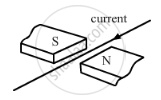
A current flows in a wire running between the S and N poles of a magnet lying horizontally as shown in Figure below:
The force on the wire due to the magnet is directed:
fron N to S
from S to N
vertically downwards
vertically upwards
State condition when magnitude of force on a current carrying conductor placed in a magnetic field is maximum?
Name and state the law which is used to determine the direction of force on a current carrying conductor placed in a magnetic field.
The north pole of Earth’s magnet is in the ____________.
A current-carrying conductor is held in an exactly vertical direction. In order to produce a clockwise magnetic field around the conductor, the current should be passed in the conductor:
The shape of the magnetic field lines produced by a current-carrying conductor is ____________.
If the strength of the current flowing through a wire is increased, the strength of the magnetic field produced by it ______.
