Advertisements
Advertisements
Question
|
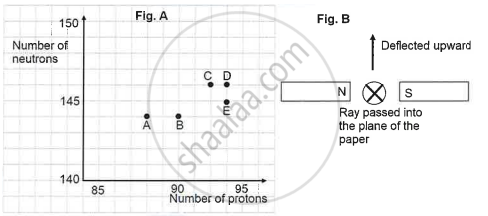
The graph (fig A) illustrates the correlation between the number of protons (x-axis) and the number of neutrons (y-axis) for elements A, B, C, D, and E in the periodic table. These elements are denoted by the letters rather than their conventional symbols. When the element C, depicted in the graph, undergoes radioactive decay, it releases radioactive rays. When these rays are directed into the plane of the paper in the presence of a magnetic field, as indicated in the fig B, they experience deflection, causing them to move upwards.
|
Identify the daughter element from the graph.
Advertisements
Solution
Explanation:
Different kinds of radiation can be released by elements during radioactive decay. The kind of radiation released is indicated by the way the rays in a magnetic field are deflected. Positively charged alpha particles would be deflected below, negatively charged beta particles would be deflected upward, and neutral gamma rays would not be deflected. The upward deflection of the beams suggests that element C emits beta radiation. The element with one fewer proton than element C is the daughter element, which may be found by examining the graph. The law of conservation of charge, which stipulates that the total charge before and after the decay must be constant, is used to determine the kind of radiation.
Step 1:
Based on the rays' deflection, determine the kind of radiation that element C emits. The rays are beta particles because they travel upward when a magnetic field is present.
Step 2:
Look at the graph to determine the daughter element. If element C has a certain number of protons, the daughter element will have one less proton.
Step 3:
State the law used to identify the radiation type, which is the law of conservation of charge.
a: Beta radiation b: Element D (assuming it has one less proton than C) c: Law of conservation of charge
