Advertisements
Advertisements
प्रश्न
|
The graph (fig A) illustrates the correlation between the number of protons (x-axis) and the number of neutrons (y-axis) for elements A, B, C, D, and E in the periodic table. These elements are denoted by the letters rather than their conventional symbols. When the element C, depicted in the graph, undergoes radioactive decay, it releases radioactive rays. When these rays are directed into the plane of the paper in the presence of a magnetic field, as indicated in the fig B, they experience deflection, causing them to move upwards.
|
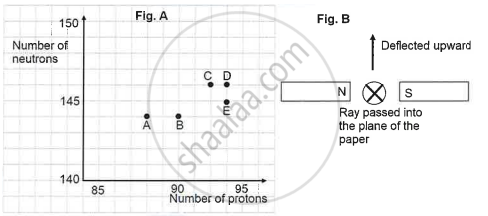
Name the law used to identify the radioactive radiation emitted by the element.
Advertisements
उत्तर
In Figure B, a magnetic field is applied perpendicular to the direction of the radioactive ray. The ray is deflected upward, indicating the type of particle based on the direction of force.
According to Fleming’s Left-Hand Rule, the direction of motion (force) on a charged particle in a magnetic field depends on:
- Thumb → Force (motion)
- Forefinger → Magnetic field (North to South)
- Middle finger → Current (positive charge flow)
Since the particle is deflected upward, and it is moving into the plane of the paper, it must be positively charged, like an alpha (α) particle.
So, Fleming’s Left-Hand Rule helps in identifying the ray as positively charged, i.e., alpha radiation.
APPEARS IN
संबंधित प्रश्न
Which of the following property of a proton can change while it moves freely in a magnetic field? (There may be more than one correct answer.)
Fill in the following blank with suitable words:
For a current-carrying solenoid, the magnetic field is like that of a ...........
A current-carrying straight wire is held in exactly vertical position. If the current passes through this wire in the vertically upward direction, what is the direction of magnetic field produced by it? Name the rule used to find the direction of magnetic field.
The magnetic field associated with a current-carrying straight conductor is in anticlockwise direction. If the conductor was held along the east-west direction, what will be the direction of current through it? Name and state the rule applied to determine the direction of current?
Name one device whose working depends on the force exerted on a current-carrying coil placed in a magnetic field.
State condition when magnitude of force on a current carrying conductor placed in a magnetic field is maximum?
How will the direction of force be changed, if the current is reversed in the conductor placed in a magnetic field?
State the unit of magnetic field in terms of the force experienced by a current carrying conductor placed in a magnetic field
State whether a magnetic field is associated or not around a moving charge.
An alpha particle enters a uniform magnetic field as shown. The direction of force experienced by the alpha particle is ______.

