Advertisements
Advertisements
प्रश्न
State under what conditions force acting on a current carrying conductor which is freely suspended in a magnetic field can be maximum.
Advertisements
उत्तर
This force F is maximum when the magnetic field due to flow of current in the conductor and the given magnetic field B are perpendicular to each other.
संबंधित प्रश्न
When is the force experienced by a current-carrying conductor placed in a magnetic field largest?
Name and state the rule to determine the direction of magnetic field around a straight current-carrying conductor.
The front face of a circular wire carrying current behaves like a north pole. The direction of current in this face of circular wire is:
(a) clockwise
(b) downwards
(c) anticlockwise
(d) upwards
What happens when a current-carrying conductor is placed in a magnetic field?
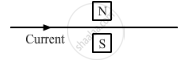
Which way does the wire in the diagram below tend to move?
A flat coil ABCD is freely suspended between the pole of a U-shaped permanent magnet with the plane of coil parallel to the magnetic field.
Name an instrument which makes use of the principle stated above.
State under what conditions force acting on a current carrying conductor which is freely suspended in a magnetic field can be Zero.
A current-carrying conductor is held in an exactly vertical direction. In order to produce a clockwise magnetic field around the conductor, the current should be passed in the conductor:
The direction of force on a current carrying conductor in a magnetic field is given by ____________.
Two LED bulbs of 10W and 5W are connected in series. If the current flowing through 5W bulb is 0.005A, the current flowing through 10W bulb is ______.
