Advertisements
Advertisements
प्रश्न
A coil ABCD mounted on an axle is placed between the poles N and S of a permanent magnet as shown in Figure.
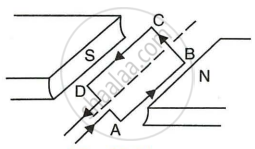
- In which direction will the coil begin to rotate when current is passed through the coil in direction ABCD by connecting a battery at the ends A and D of the coil?
- Why is a commutator necessary for continuous rotation of the coil?
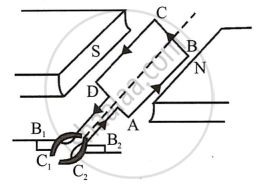
- Complete the diagram with commutator, etc. for the flow of current in the coil?
Advertisements
उत्तर
- The coil begins to rotate in anticlockwise direction.
- This is because, after half rotation, the arms AB and CD get interchanged, so the direction of torque on coil reverses. To keep the coil rotating in same direction, commutator is needed to change the direction of current in the coil after each half rotation of coil.
APPEARS IN
संबंधित प्रश्न
Which of the following correctly describes the magnetic field near a long straight wire?
List three ways in which the magnetic field strength of a current-carrying solenoid can be increased?
The magnetic field lines in the middle of the current-carrying solenoid are?
(a) circles
(b) spirals
(c) parallel to the axis of the tube
(d) perpendicular to the axis of the tube
In a statement of Fleming's left-hand rule, what do the following represent?
(a) direction of centre finger.
(b) direction of forefinger.
(c) direction of thumb.
State two ways to increase the force on a current-carrying conductor in a magnetic held.
The force exerted on a current-carrying wire placed in a magnetic field is zero when the angle between the wire and the direction of magnetic field is:
45°
60°
90°
180°
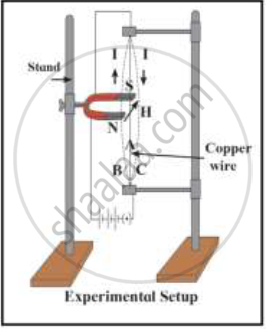
force experienced by a current-carrying straight conductor placed in a magnetic field which is perpendicular to it.
i) Which principle is explained in this figure?
ii) Which rule is used to find out the direction of a force in this principle?
iii) In which machine this principle is used? Draw a diagram showing working of that machine
Write Fleming’s left hand rule.
An alpha particle enters a uniform magnetic field as shown. The direction of force experienced by the alpha particle is ______.

