Advertisements
Advertisements
प्रश्न
Describe the activity that shows that a current-carrying conductor experiences a force perpendicular to its length and the external magnetic field. How does Fleming’s left-hand rule help us to find the direction of the force acting on the current carrying conductor?
Advertisements
उत्तर
The activity is as follows:
Take a small aluminum rod AB. Using two connecting wires suspend it horizontally from a stand, as shown in the figure given below.
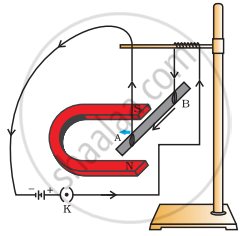
A current- carrying rod AB experiences a force perpendicularto its length and the magnetic field
Place a strong horseshoe magnet in such a way that the rod lies between the two poles with the magnetic field directed upwards. For this put the North Pole of the magnet vertically below and the South Pole vertically above the aluminium rod.
Connect the aluminium rod in series with a battery, a key and a rheostat.
Now pass a current through the aluminium rod from end B to end A.
It is observed that the rod gets displaced towards the left due to the force experienced by it.
Fleming’s left-hand rule is used to find the direction of the force acting on the current carrying conductor. According to this rule, stretch the thumb, forefinger and middle finger of your left hand such that they are mutually perpendicular as shown in the diagram. If the first finger points in the direction of magnetic field and the second finger in the direction of current, then the thumb will point in the direction of motion or the force acting on the conductor.
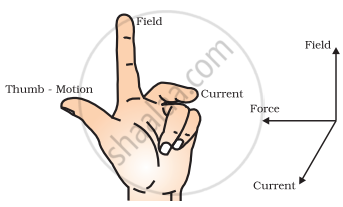
Fleming's left - hand rule
APPEARS IN
संबंधित प्रश्न
Consider a circular loop of wire lying in the plane of the table. Let the current pass through the loop clockwise. Apply the right-hand rule to find out the direction of the magnetic field inside and outside the loop.
The magnetic field in a given region is uniform. Draw a diagram to represent it.
The magnetic field inside a long straight solenoid-carrying current ______.
What is the shape of a current-carrying conductor whose magnetic field pattern resembles that of a bar magnet?
Fill in the following blank with suitable words:
For a current-carrying solenoid, the magnetic field is like that of a ...........
Name any two factors on which the strength of magnetic field produced by a current-carrying solenoid depends. How does it depend on these factors?
What is a solenoid? Draw a sketch to show the magnetic field pattern produced by a current-carrying solenoid.
What is the shape of field lines inside a current-carrying solenoid? What does the pattern of field lines inside a current-carrying solenoid indicate?
The front face of a circular wire carrying current behaves like a north pole. The direction of current in this face of circular wire is:
(a) clockwise
(b) downwards
(c) anticlockwise
(d) upwards
In a statement of Fleming's left-hand rule, what do the following represent?
(a) direction of centre finger.
(b) direction of forefinger.
(c) direction of thumb.
Name and state the law which is used to determine the direction of force on a current carrying conductor placed in a magnetic field.
A flat coil ABCD is freely suspended between the pole of a U-shaped permanent magnet with the plane of coil parallel to the magnetic field.
Name an instrument which makes use of the principle stated above.
Differentiate between conductors and insulators.
State whether a magnetic field is associated or not around a moving charge.
The north pole of Earth’s magnet is in the ____________.
When current is parallel to a magnetic field, then force experience by the current-carrying conductor placed in a uniform magnetic field is ____________.
The direction of force on a current carrying conductor in a magnetic field is given by ____________.
A simple motor is made in a school laboratory. A coil of wire is mounted on an axle between the poles of a horseshoe magnet, as illustrated.

In the example above, coil ABCD is horizontal and the battery is connected as shown.
- For this position, state the direction of the force on the arm AB.
- Why does the current in the arm BC not contribute to the turning force on the coil?
Assertion (A): A magnetic field exerts a force on a moving charge in the same direction as the direction of the field itself.
Reason (R): The direction of force is given by Fleming’s left-hand rule.
Observe the given figure of Fleming's Left Hand Rule and write the labels of 'A' and 'B':

