Advertisements
Advertisements
प्रश्न
Describe the activity that shows that a current-carrying conductor experiences a force perpendicular to its length and the external magnetic field. How does Fleming’s left-hand rule help us to find the direction of the force acting on the current carrying conductor?
Advertisements
उत्तर
The activity is as follows:
Take a small aluminum rod AB. Using two connecting wires suspend it horizontally from a stand, as shown in the figure given below.
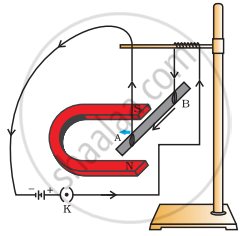
A current- carrying rod AB experiences a force perpendicularto its length and the magnetic field
Place a strong horseshoe magnet in such a way that the rod lies between the two poles with the magnetic field directed upwards. For this put the North Pole of the magnet vertically below and the South Pole vertically above the aluminium rod.
Connect the aluminium rod in series with a battery, a key and a rheostat.
Now pass a current through the aluminium rod from end B to end A.
It is observed that the rod gets displaced towards the left due to the force experienced by it.
Fleming’s left-hand rule is used to find the direction of the force acting on the current carrying conductor. According to this rule, stretch the thumb, forefinger and middle finger of your left hand such that they are mutually perpendicular as shown in the diagram. If the first finger points in the direction of magnetic field and the second finger in the direction of current, then the thumb will point in the direction of motion or the force acting on the conductor.
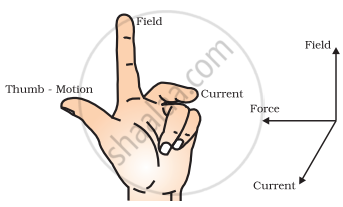
Fleming's left - hand rule
APPEARS IN
संबंधित प्रश्न
The magnetic field in a given region is uniform. Draw a diagram to represent it.
Which of the following property of a proton can change while it moves freely in a magnetic field? (There may be more than one correct answer.)
Observe the following figure:

If the current in the coil A is changed, will some current be induced in the coil B? Explain.
What concealed do you get from the observation that a current-carrying wire deflects a compass needle placed near it?
State qualitatively the effect of inserting an iron core into a current-carrying solenoid.
State whether the following statement is true or false:
The magnetic field inside a long circular coil carrying current well be parallel straight lines.
What are the various ways in which the strength of magnetic field produced by a current-carrying circular coil can be increased?
Name one device whose working depends on the force exerted on a current-carrying coil placed in a magnetic field.
A horizontal wire carries a current as shown in Figure below between magnetic poles N and S:
Is the direction of the force on the wire due to the magnet:
(a) in the direction the current
(b) vertically downwards
(c) opposite to the current direction
(d) vertically upwards
A flat coil ABCD is freely suspended between the pole of U-shaped permanent magnet with the plane of coil parallel to the magnetic field.
What happens when a current is passed in the coil?
Name the following diagram and explain the concept behind it.

State Fleming’s left-hand rule.
The north pole of Earth’s magnet is in the ____________.
The strength of magnetic field around a current-carrying conductor is ____________.
For a current in a long straight solenoid N- and S-poles are created at the two ends. Among the following statements, the incorrect statement is
Which of the following pattern correctly describes the magnetic field around a long straight wire carrying current?
|
The graph (fig A) illustrates the correlation between the number of protons (x-axis) and the number of neutrons (y-axis) for elements A, B, C, D, and E in the periodic table. These elements are denoted by the letters rather than their conventional symbols. When the element C, depicted in the graph, undergoes radioactive decay, it releases radioactive rays. When these rays are directed into the plane of the paper in the presence of a magnetic field, as indicated in the fig B, they experience deflection, causing them to move upwards.
|
Name the law used to identify the radioactive radiation emitted by the element.

