हिंदी

In the Simple Electric Motor of Figure Given Below, the Coil Rotates Anticlockwise as Seen by the Eye from the Position X When Current Flows in the Coil - Science

Advertisements
Advertisements

प्रश्न

In the simple electric motor of figure given below, the coil rotates anticlockwise as seen by the eye from the position X when current flows in the coil  
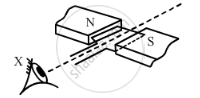
 

Is the current flowing clockwise or anticlockwise around the coil when viewed from above? 

Advertisements

उत्तर

The current is flowing in clockwise direction around the coil when viewed from above.
Using Fleming's left-hand rule, the direction of current can be found.

shaalaa.com
  क्या इस प्रश्न या उत्तर में कोई त्रुटि है?
अध्याय 2: Magnetic Effects of Electric Current - Exercise 3 [पृष्ठ ९३]

APPEARS IN

लखमीर सिंग Physics (Science) [English] Class 10
अध्याय 2 Magnetic Effects of Electric Current
Exercise 3 | Q 31 | पृष्ठ ९३

संबंधित प्रश्न

The magnetic field in a given region is uniform. Draw a diagram to represent it.


Which of the following correctly describes the magnetic field near a long straight wire?


When is the force experienced by a current-carrying conductor placed in a magnetic field largest?


State Fleming’s left hand rule.


State whether the following statement is true or false:
The magnetic field inside a long circular coil carrying current well be parallel straight lines.


What is the shape of a current-carrying conductor whose magnetic field pattern resembles that of a bar magnet?


Name and state the rule to determine the direction of magnetic field around a straight current-carrying conductor.


Name any two factors on which the strength of magnetic field produced by a current-carrying solenoid depends. How does it depend on these factors?


A soft iron bar is inserted inside a current-carrying solenoid. The magnetic field inside the solenoid:

(a) will decrease
(b) will increase
(c) will become zero
(d) will remain the same


The force exerted on a current-carrying wire placed in a magnetic field is zero when the angle between the wire and the direction of magnetic field is: 

 45°
 60°
 90°
 180°


 force experienced by a current-carrying straight conductor placed in a magnetic field which is perpendicular to it. 


Two coils A and B of insulated wire are kept close to each other. Coil A is connected to a galvanometer while coil B is connected to a battery through a key. What would happen if: 

the current is stopped by removing the plug from the key? 

Explain your answer mentioning the name of the phenomenon involved. 


State condition when magnitude of force on a current carrying conductor placed in a magnetic field is maximum?


Name and state the law which is used to determine the direction of force on a current carrying conductor placed in a magnetic field.


A flat coil ABCD is freely suspended between the pole of a U-shaped permanent magnet with the plane of coil parallel to the magnetic field. 

When will coil come to rest?


A current-carrying conductor is held in an exactly vertical direction. In order to produce a clockwise magnetic field around the conductor, the current should be passed in the conductor:


Describe the activity that shows that a current-carrying conductor experiences a force perpendicular to its length and the external magnetic field. How does Fleming’s left-hand rule help us to find the direction of the force acting on the current carrying conductor?


Assertion (A): A current carrying straight conductor experiences a force when placed perpendicular to the direction of magnetic field.

Reason (R): The net charge on a current carrying conductor is always zero.


The graph (fig A) illustrates the correlation between the number of protons (x-axis) and the number of neutrons (y-axis) for elements A, B, C, D, and E in the periodic table. These elements are denoted by the letters rather than their conventional symbols. When the element C, depicted in the graph, undergoes radioactive decay, it releases radioactive rays. When these rays are directed into the plane of the paper in the presence of a magnetic field, as indicated in the fig B, they experience deflection, causing them to move upwards.

Name the law used to identify the radioactive radiation emitted by the element.


Share
Notifications

Englishहिंदीमराठी


      Forgot password?
Use app×