Advertisements
Advertisements
प्रश्न
A copper wire is held between the poles of a magnet
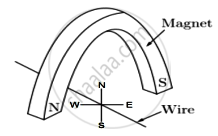
The current in the wire can be reversed. The pole of the magnet can also be changed over. In how many of the four directions shown can the force act on the wire?
विकल्प
1
2
3
4
Advertisements
उत्तर
2 (Either North or South)
APPEARS IN
संबंधित प्रश्न
State Fleming’s left-hand rule.
For Fleming's left-hand rule, write down the three things that are 90° to each other, and next to each one write down the finger or thumb that represents it.
The force experienced by a current-carrying conductor placed in a magnetic field is the largest when the angle between the conductor and the magnetic field is:
45°
60°
90°
180°
Which way does the wire in the diagram below tend to move?
What is the force on a current-carrying wire that is parallel to a magnetic field? Give reason for your answer.
State whether a magnetic field is associated or not around a static charge.
State whether a magnetic field is associated or not around a moving charge.
When current is parallel to a magnetic field, then force experience by the current-carrying conductor placed in a uniform magnetic field is ____________.
A simple motor is made in a school laboratory. A coil of wire is mounted on an axle between the poles of a horseshoe magnet, as illustrated.

In the example above, coil ABCD is horizontal and the battery is connected as shown.
- For this position, state the direction of the force on the arm AB.
- Why does the current in the arm BC not contribute to the turning force on the coil?
Which of the following pattern correctly describes the magnetic field around a long straight wire carrying current?
