Advertisements
Advertisements
प्रश्न
A copper wire is held between the poles of a magnet
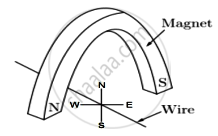
The current in the wire can be reversed. The pole of the magnet can also be changed over. In how many of the four directions shown can the force act on the wire?
पर्याय
1
2
3
4
Advertisements
उत्तर
2 (Either North or South)
APPEARS IN
संबंधित प्रश्न
Which of the following property of a proton can change while it moves freely in a magnetic field? (There may be more than one correct answer.)
State Fleming’s left-hand rule.
What type of core should be put inside a current-carrying solenoid to make an electromagnet?
A current-carrying straight wire is held in exactly vertical position. If the current passes through this wire in the vertically upward direction, what is the direction of magnetic field produced by it? Name the rule used to find the direction of magnetic field.
For Fleming's left-hand rule, write down the three things that are 90° to each other, and next to each one write down the finger or thumb that represents it.
Name and state the rule of determine the direction of force experienced by a current carrying straight conductor placed in a uniform magnetic field which is perpendicular to it.
Write Fleming’s left hand rule.
The shape of the magnetic field lines produced by a current-carrying conductor is ____________.
What does the direction of thumb indicate in the right-hand thumb rule. In what way this rule is different from Fleming’s left-hand rule?
Describe the activity that shows that a current-carrying conductor experiences a force perpendicular to its length and the external magnetic field. How does Fleming’s left-hand rule help us to find the direction of the force acting on the current carrying conductor?
