Advertisements
Advertisements
प्रश्न
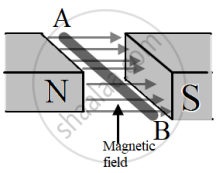
Observe the given figure of Fleming's Left Hand Rule and write the labels of 'A' and 'B':

Advertisements
उत्तर

APPEARS IN
संबंधित प्रश्न
Consider a circular loop of wire lying in the plane of the table. Let the current pass through the loop clockwise. Apply the right-hand rule to find out the direction of the magnetic field inside and outside the loop.
Which of the following property of a proton can change while it moves freely in a magnetic field? (There may be more than one correct answer.)
Which of the following property of a proton can change while it moves freely in a magnetic field? (There may be more than one correct answer.)
Which of the following correctly describes the magnetic field near a long straight wire?
State Fleming’s left hand rule.
State qualitatively the effect of inserting an iron core into a current-carrying solenoid.
State whether the following statement is true or false:
The magnetic field inside a long circular coil carrying current well be parallel straight lines.
Fill in the following blank with suitable words:
For a current-carrying solenoid, the magnetic field is like that of a ...........
Describe how you will locate a current-carrying wire concealed in a wall.
Name and state the rule to determine the direction of magnetic field around a straight current-carrying conductor.
The magnetic field associated with a current-carrying straight conductor is in anticlockwise direction. If the conductor was held along the east-west direction, what will be the direction of current through it? Name and state the rule applied to determine the direction of current?
A current-carrying conductor is held in exactly vertical direction. In order to produce a clockwise magnetic field around the conductor, the current should passed in the conductor:
(a) from top towards bottom
(b) from left towards right
(c) from bottom towards top
(d) from right towards left
What happens when a current-carrying conductor is placed in a magnetic field?
In a statement of Fleming's left-hand rule, what do the following represent?
(a) direction of centre finger.
(b) direction of forefinger.
(c) direction of thumb.
For Fleming's left-hand rule, write down the three things that are 90° to each other, and next to each one write down the finger or thumb that represents it.
State two ways to increase the force on a current-carrying conductor in a magnetic held.
In the simple electric motor of figure given below, the coil rotates anticlockwise as seen by the eye from the position X when current flows in the coil
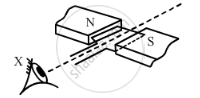
Is the current flowing clockwise or anticlockwise around the coil when viewed from above?
Two coils A and B of insulated wire are kept close to each other. Coil A is connected to a galvanometer while coil B is connected to a battery through a key. What would happen if:
the current is stopped by removing the plug from the key?
Explain your answer mentioning the name of the phenomenon involved.
State condition when magnitude of force on a current carrying conductor placed in a magnetic field is maximum?
State two ways to increase the speed of rotation of a D.C. motor.
State Fleming’s left-hand rule.
State under what conditions force acting on a current carrying conductor which is freely suspended in a magnetic field can be maximum.
State under what conditions force acting on a current carrying conductor which is freely suspended in a magnetic field can be Zero.
The shape of the magnetic field lines produced by a current-carrying conductor is ____________.
The strength of magnetic field around a current-carrying conductor is ____________.
Which of the following factors affect the strength of force experience by current-carrying conduct in a uniform magnetic field?
A magnetic field directed in north direction acts on an electron moving in east direction. The magnetic force on the electron will act ____________.
The direction of force on a current carrying conductor in a magnetic field is given by ____________.
The diagram below shows a free conductor AB is kept in a magnetic field and is carrying current from A to B. (To avoid confusion complete path of the circuit is not shown) The direction of the force experienced by the conductor will be:
Assertion (A): A magnetic field exerts a force on a moving charge in the same direction as the direction of the field itself.
Reason (R): The direction of force is given by Fleming’s left-hand rule.
Which of the following pattern correctly describes the magnetic field around a long straight wire carrying current?
Two LED bulbs of 10W and 5W are connected in series. If the current flowing through 5W bulb is 0.005A, the current flowing through 10W bulb is ______.
A copper conductor is placed over two stretched copper wires whose ends ate connected to a D.C. supply as shown in the diagram.
- What should be the magnetic poles at the points A and B lying on either side of the conductor to experience the force in the upward direction?
- Name the law used to find these polarities.

