Advertisements
Advertisements
प्रश्न
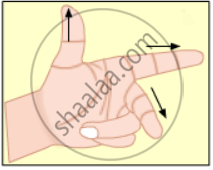
Observe the given figure of Fleming's Left Hand Rule and write the labels of 'A' and 'B':

Advertisements
उत्तर

APPEARS IN
संबंधित प्रश्न
Consider a circular loop of wire lying in the plane of the table. Let the current pass through the loop clockwise. Apply the right-hand rule to find out the direction of the magnetic field inside and outside the loop.
Which of the following property of a proton can change while it moves freely in a magnetic field? (There may be more than one correct answer.)
State Fleming’s left-hand rule.
Imagine that you are sitting in a chamber with your back to one wall. An electron beam, moving horizontally from back wall towards the front wall, is deflected by a strong magnetic field to your right side. What is the direction of magnetic field?
State the rule to determine the direction of a force experienced by a current-carrying straight conductor placed in a magnetic field which is perpendicular to it.
Observe the following figure:

If the current in the coil A is changed, will some current be induced in the coil B? Explain.
State qualitatively the effect of inserting an iron core into a current-carrying solenoid.
State the form of magnetic field lines around a straight current-carrying conductor.
Fill in the following blank with suitable words:
For a current-carrying solenoid, the magnetic field is like that of a ...........
What is the shape of field lines inside a current-carrying solenoid? What does the pattern of field lines inside a current-carrying solenoid indicate?
List three ways in which the magnetic field strength of a current-carrying solenoid can be increased?
For Fleming's left-hand rule, write down the three things that are 90° to each other, and next to each one write down the finger or thumb that represents it.
A current-carrying conductor is placed perpendicularly in a magnetic field. Name the rule which can be used to find the direction of force acting on the conductor.
State two ways to increase the force on a current-carrying conductor in a magnetic held.
A current flows in a wire running between the S and N poles of a magnet lying horizontally as shown in Figure below:
The force on the wire due to the magnet is directed:
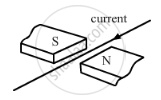
fron N to S
from S to N
vertically downwards
vertically upwards
A horizontal wire carries a current as shown in Figure below between magnetic poles N and S:
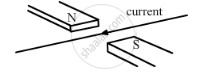
Is the direction of the force on the wire due to the magnet:
(a) in the direction the current
(b) vertically downwards
(c) opposite to the current direction
(d) vertically upwards
In the simple electric motor of figure given below, the coil rotates anticlockwise as seen by the eye from the position X when current flows in the coil
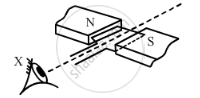
Is the current flowing clockwise or anticlockwise around the coil when viewed from above?
What is the force on a current-carrying wire that is parallel to a magnetic field? Give reason for your answer.
State the unit of magnetic field in terms of the force experienced by a current carrying conductor placed in a magnetic field
A coil ABCD mounted on an axle is placed between the poles N and S of a permanent magnet as shown in Figure.
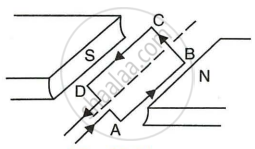
- In which direction will the coil begin to rotate when current is passed through the coil in direction ABCD by connecting a battery at the ends A and D of the coil?
- Why is a commutator necessary for continuous rotation of the coil?
- Complete the diagram with commutator, etc. for the flow of current in the coil?
Name the following diagram and explain the concept behind it.
Name and state the rule of determine the direction of force experienced by a current carrying straight conductor placed in a uniform magnetic field which is perpendicular to it.
State Fleming’s left-hand rule.
A flat coil ABCD is freely suspended between the pole pieces of a U-shaped permanent magnet with the plane of coil parallel to the magnetic field.
When will the couple acting on the coil be
- maximum
- minimum?
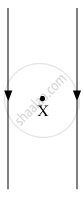
The following diagram shows two parallel straight conductors carrying the same current. Copy the diagram and draw the pattern of the magnetic field lines around them showing their directions. What is the magnitude of the magnetic field at a point 'X' which is equidistant from the conductors? Give justification for your answer.
State whether a magnetic field is associated or not around a static charge.
State under what conditions force acting on a current carrying conductor which is freely suspended in a magnetic field can be maximum.
Write Fleming’s left hand rule.
A current flows in a wire running between the S and N poles of a magnet lying horizontally as shown in the figure below:

The force on the wire due to the magnet is directed ____________.
Describe the activity that shows that a current-carrying conductor experiences a force perpendicular to its length and the external magnetic field. How does Fleming’s left-hand rule help us to find the direction of the force acting on the current carrying conductor?
A simple motor is made in a school laboratory. A coil of wire is mounted on an axle between the poles of a horseshoe magnet, as illustrated.

In the example above, coil ABCD is horizontal and the battery is connected as shown.
- For this position, state the direction of the force on the arm AB.
- Why does the current in the arm BC not contribute to the turning force on the coil?
Which of the following pattern correctly describes the magnetic field around a long straight wire carrying current?
If the strength of the current flowing through a wire is increased, the strength of the magnetic field produced by it ______.
|
The graph (fig A) illustrates the correlation between the number of protons (x-axis) and the number of neutrons (y-axis) for elements A, B, C, D, and E in the periodic table. These elements are denoted by the letters rather than their conventional symbols. When the element C, depicted in the graph, undergoes radioactive decay, it releases radioactive rays. When these rays are directed into the plane of the paper in the presence of a magnetic field, as indicated in the fig B, they experience deflection, causing them to move upwards.
|
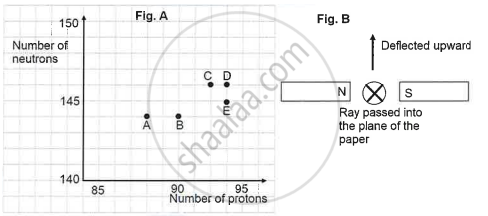
Name the law used to identify the radioactive radiation emitted by the element.
