Advertisements
Advertisements
Question
Advertisements
Solution
Fleming’s left hand rule is used to find out the direction of Lorentz force on a conductor.
APPEARS IN
RELATED QUESTIONS
Imagine that you are sitting in a chamber with your back to one wall. An electron beam, moving horizontally from back wall towards the front wall, is deflected by a strong magnetic field to your right side. What is the direction of magnetic field?
State and explain the clock-face rule for determining the polarities of a circular wire carrying current.
Name any two factors on which the strength of magnetic field produced by a current-carrying solenoid depends. How does it depend on these factors?
When is the force experienced by a current-carrying conductor placed in a magnetic field largest?
For Fleming's left-hand rule, write down the three things that are 90° to each other, and next to each one write down the finger or thumb that represents it.
A horizontal wire carries a current as shown in Figure below between magnetic poles N and S:
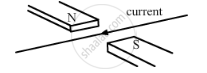
Is the direction of the force on the wire due to the magnet:
(a) in the direction the current
(b) vertically downwards
(c) opposite to the current direction
(d) vertically upwards
What is the force on a current-carrying wire that is parallel to a magnetic field? Give reason for your answer.
A coil ABCD mounted on an axle is placed between the poles N and S of a permanent magnet as shown in Figure.
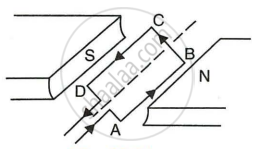
- In which direction will the coil begin to rotate when current is passed through the coil in direction ABCD by connecting a battery at the ends A and D of the coil?
- Why is a commutator necessary for continuous rotation of the coil?
- Complete the diagram with commutator, etc. for the flow of current in the coil?
A flat coil ABCD is freely suspended between the pole pieces of a U-shaped permanent magnet with the plane of coil parallel to the magnetic field.
When will the couple acting on the coil be
- maximum
- minimum?
Assertion (A): A magnetic field exerts a force on a moving charge in the same direction as the direction of the field itself.
Reason (R): The direction of force is given by Fleming’s left-hand rule.
