Advertisements
Advertisements
Question
Advertisements
Solution
Precautions while using electricity:
(i) One must use wires or cables of current carrying capacity higher than the current which can flow through the circuit while using all appliances.
(ii) An electrical appliance must never be operated (or touched) with wet hands.
RELATED QUESTIONS
The SI unit of charge is volt.
What does an electric circuit mean?
Fill in the blank:
To increase the effective resistance in a circuit the resistors are connected in _____________.
Draw the electrical symbols of the following components and state its use:
Rheostat (variable resistance)
In which direction does conventional current flow around a circuit?
If 20 C of charge pass a point in a circuit in 1 s, what current is flowing?
In 10 s, a charge of 25 C leaves a battery, and 200 J of energy are delivered to an outside circuit as a result.
- What is the p.d. across the battery?
- What current flows from the battery?
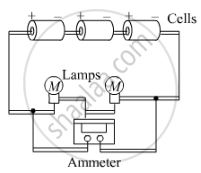
A student made an electric circuit shown here to measure the current through two lamps.
Are the lamps in series or parallel?
(a) Are the lamps in series or parallel?
(b) The student has made a mistake in this circuit. What is the mistake?
(c) Draw a circuit diagram to show the correct way to connect the circuit. Use the proper circuit symbols in your diagram.
V1, V2 and V3 are the p.ds. across the 1Ω, 2Ω and 3Ω resistors in the following diagram, and the current is 5 A.
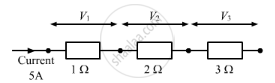
Which one of the columns (a) to (d) shows the correct values of V1, V2 and V3measured in volts?
`V_1` `V_2` `V_3`
(a) 1.0 2.0 3.0
(b) 5.0 10.0 15.0
(c) 5.0 2.5 1.6
(d) 4.0 4.0 2.0
Which type of circuit, series or parallel, is preferred while connecting a large number of bulbs:
(b) for lighting inside the rooms of the hotel?
Give three reasons why different electrical appliances in a domestic circuit are connected in parallel.
Ten bulbs are connected in a series circuit to a power supply line. Ten identical bulbs are connected in a parallel circuit to an identical power supply line.
- Which circuit would have the highest voltage across each bulb?
- In which circuit would the bulbs be brighter?
- In which circuit, if one bulb blows out, all others will stop glowing?
- Which circuit would have less current in it?
If you were going to connect two light bulbs to one battery, would you use a series or a parallel arrangement? Why? Which arrangement takes more current from the battery?
The rating of a fuse connected in the lighting circuit is ______.
A wire of uniform thickness with a resistance of 27Ω is cut into three equal pieces and they are joined in parallel. Find the equivalent resistance of the parallel combination.
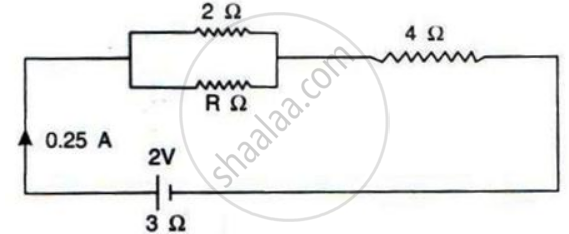
The following circuit diagram shows three resistors 2 Ω, 4 Ω and R Ω connected to a battery of e.m.f 2V and internal resistance 3 Ω. If the main current of 0.25 A flows through the circuit, find:
- the p.d. across the 4 Ω resistors,
- the p.d. across the internal resistance of the cell,
- the p.d. across the R Ω or 2 Ω resistors, and
- the value of R.
State the relation between work, charge and potential difference for an electric circuit.
The work done in moving unit positive charge across two points in an electric circuit is a measure of
Tick(✓) the correct choice in the following:
The outer casing of an electric iron is generally connected to earth in order
to
Complete the following table. The first answer has been given as an example.
| Quantity | Unit | |
| (a) | Electrical potential | volt |
| (b) | Resistance | ........ |
| (c) | Power | ........ |
| (d) | Energy | ........ |
| (e) | Resistivity | ........ |
What is the criteria for selecting a fuse wire?
60 joules of heat was dissipated in a resistor when 20 C flowed for 5 s. Calculate:
(a) P.d. across the resistor,
(b) Resistance of the resistor, and
(c) Average power dissipated in the resistor.
A bulb is connected to a battery of p.d. 4 V and internal resistance 2.5 Ω . A steady current of 0.5 A flows through the circuit. Calculate:
The resistance of the bulb
Which part of an electrical appliance is earthed?
What is the speed of electric current?
State whether true or false. If false, correct the statement.
Current can produce magnetic field.
One unit of electrical energy consumed is equal to 1000 kilowatt-hour.
