Advertisements
Advertisements
Question
Complete the following table. The first answer has been given as an example.
| Quantity | Unit | |
| (a) | Electrical potential | volt |
| (b) | Resistance | ........ |
| (c) | Power | ........ |
| (d) | Energy | ........ |
| (e) | Resistivity | ........ |
Advertisements
Solution
| Quantity | Unit | |
| (a) | Electrical potential | volt |
| (b) | Resistance | ohm |
| (c) | Power | watt |
| (d) | Energy | Joule |
| (e) | Resistivity | Ohm-meter |
APPEARS IN
RELATED QUESTIONS
Why are metals good conductors of electricity whereas glass is a bad conductor of electricity? Give reason?
A Radio Set Draws a Current of 0.36 a for 15 Minutes. Calculate the Amount of Electric Charge that Flows Through the Circuit.
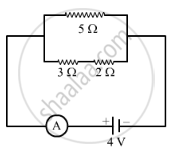
(a) With the help of a circuit diagram, obtain the relation for the equivalent resistance of two resistances connected in parallel.
(b) In the circuit diagram shown below, find:
(i) Total resistance.
(ii) Current shown by the ammeter A
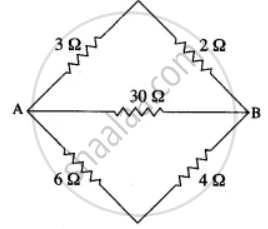
Calculate the equivalent resistance between A and B in the adjacent diagram.
Tick(✓) the correct choice in the following:
The outer casing of an electric iron is generally connected to earth in order
to
State the S.I. units of electrical power.
Answer the following question.
What is the function of a galvanometer in a circuit?
1020 electrons, each having a charge of 1.6 x 10⁻¹⁹ C, flows in a circuit V is 0.1s. What is the current in ampere?
