Advertisements
Advertisements
प्रश्न
Complete the following table. The first answer has been given as an example.
| Quantity | Unit | |
| (a) | Electrical potential | volt |
| (b) | Resistance | ........ |
| (c) | Power | ........ |
| (d) | Energy | ........ |
| (e) | Resistivity | ........ |
Advertisements
उत्तर
| Quantity | Unit | |
| (a) | Electrical potential | volt |
| (b) | Resistance | ohm |
| (c) | Power | watt |
| (d) | Energy | Joule |
| (e) | Resistivity | Ohm-meter |
APPEARS IN
संबंधित प्रश्न
Define the unit of current.
What actually travels through the wires when you switch on a light?
One coulomb of charge flows through any cross-section of a conductor in 1 second. What is the current flowing through the conductor?
What is the conventional direction of the flow of electric current? How does it differ from the direction of flow electrons?
An electric bulb is rated 250 W, 230 V.
- the energy consumed in one hour, and
- the time in which the bulb will consume 1.0 kWh energy when connected to 230 V mains.
Answer the following question.
An electric lamp of resistance 20 Ω and a conductor of resistance 4 0 are connected to a 6 V battery as shown in the circuit. Calculate: 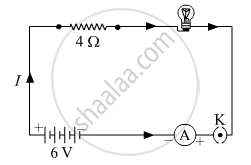
(a) the total resistance of the circuit,
(b) the current through the circuit,
(c) the potential difference across the (i) electric lamp and (ii) conductor, and
(d) power of the lamp.
