Advertisements
Advertisements
प्रश्न
The circuit diagram given below shows the combination of three resistors R1, R2 and R3:
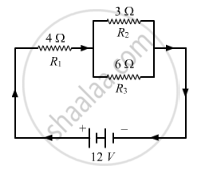
Find :
(i) total resistance of the circuit.
(ii) total current flowing in the circuit.
(iii) the potential difference across R1.
Advertisements
उत्तर
(i) As shown in the figure, the resistors R2 and R3 are connected in parallel. Their total resistance is given by:
1/R = 1/R2+ 1/R3
Here, R2 = 3 Ω
R3 = 6 Ω
So,
1/R = 1/3 + 1/6
Or 1/R = (2+1)/6
1/R = 3/6
R = 2 Ω
This resistance is in series with the resistor, R1.
Total resistance = 2 Ω + R1
R1 = 4 Ω
Therefore, total resistance = 2 Ω + 4 Ω = 6 Ω
(ii) The current through the circuit can be calculated as follows:
Current, I = V / R
I = (12 / 6) A
I = 2 A
(iii) The potential difference across R1 = 2 A x 4 Ω = 8 V
APPEARS IN
संबंधित प्रश्न
One coulomb of charge flows through any cross-section of a conductor in 1 second. What is the current flowing through the conductor?
Which type of circuit, series or parallel, is preferred while connecting a large number of bulbs:
(a) for decorating a hotel building from outside?
A wire of length 5 m has a resistance of 2.0 Ω calculate:
(a) the resistance of wire of length 1 m
(b) the equivalent resistance if two such wires each of length 2 m are joined in parallel.
(c) the resistance of 1 m length of wire of same material but of half diameter.
The following table shows the current in Amperes and potential differences in Volts.
- Find the average resistance.
- What will be the nature of the graph between the current and potential difference? (Do not draw a graph.)
- Which law will the graph prove? Explain the law.
| V (volts) | I (amp) |
| 4 | 9 |
| 5 | 11.25 |
| 6 | 13.5 |
Calculate the amount of energy transferred by a 10 A electric current flowing through a resistor of 5 o for 15 minutes.
An electric bulb is rated at 220 V, 100 W.
- What is its resistance?
- What safe current can be passed through it?
A bulb is connected to a battery of p.d. 4 V and internal resistance 2.5 Ω . A steady current of 0.5 A flows through the circuit. Calculate:
The total energy supplied by the battery in 10 minutes
Answer the following question.
What is the function of a galvanometer in a circuit?
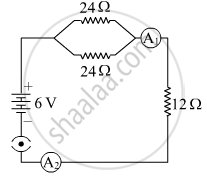
Study the following circuit and find out:
(i) Current in 12 Ω resistor.
(ii) The difference in the readings of A1 and A2, if any.
What is meant by internal resistance of a cell?
______ is used to measure the electric current.
Define an electric current.
What are the effects of electric current?
