Advertisements
Advertisements
Question
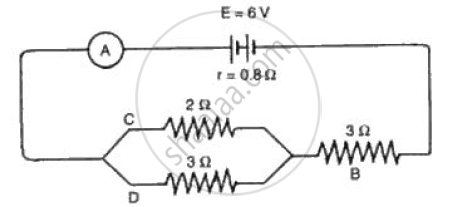
The circuit diagram (Fig.) shows a battery of e.m.f. 6 volts and internal
resistance of 0.8 Ω oonnected in series. Find the
(a) Current reoorded by the ammeter,
(b) P.d. across the terminals of the resistor B,
( c) Current passing through each of the resistors B, C and D, and
( d) P.d. across the terminals of the battery.
Advertisements
Solution
Given, emf e = 6 V, internal resistance r = 0.8Ω
In the given circuit, parallel combination of resistances 2Ω and 3Ω
is connected in series with a 3Ω resistance.
Resistance in parallel, `1/"R"_"p" = 1/2 + 1/3 = 5/6` Ω
Rp = 1.2 Ω
Total resistance of the given circuit, Rt= 0.8 + 3 + 1.2 = 5Ω
current recorded by the ammeter, I = `"e"/"R"_"t" = 6/5 = 1.2 "A"`
(b) P.d. across resistor B = 1.2 x 3 = 3.6 V
(c) Current passing through resistor B = 1. 2 A
Current through resistor C = `("I" xx 3)/ (2 + 3) = (1.2 xx 3)/5 = 0.72 "A"`
Current through resistor D = `("I" xx 2)/2 + 3 = (1.2 xx 2)/5 = 0.48 "A"`
(d) p.d. across the terminals of battery= 1.2 x 0.8 = 0.96 V
APPEARS IN
RELATED QUESTIONS
<p> Define the unit of electric current (or Define ampere).
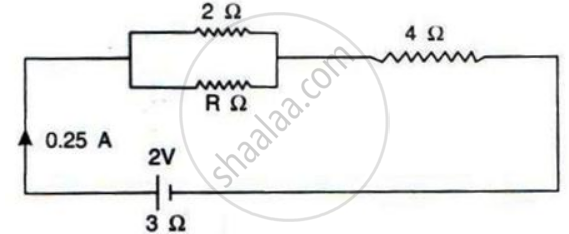
The following circuit diagram shows three resistors 2 Ω, 4 Ω and R Ω connected to a battery of e.m.f 2V and internal resistance 3 Ω. If the main current of 0.25 A flows through the circuit, find:
- the p.d. across the 4 Ω resistors,
- the p.d. across the internal resistance of the cell,
- the p.d. across the R Ω or 2 Ω resistors, and
- the value of R.
An electric current flowing in a wire creates ______ around the wire.
A bulb is connected to a battery of p.d. 4 V and internal resistance 2.5 Ω . A steady current of 0.5 A flows through the circuit. Calculate:
The resistance of the bulb
Unit of electric power may also be expressed as
Problems for practice:
If 5A current flows through a circuit, then convert the current in terms of microampere?
What are the effects of electric current?
