Advertisements
Advertisements
Question
Advertisements
Solution
APPEARS IN
RELATED QUESTIONS
What Makes an Electric Current Flow in a Wire?
Write down the formula which relates electric charge, time and electric current
Which instrument is used to measure electric current? How should it be connected in a circuit?
A car headlight bulb working on a 12 V car battery draws a current of 0.5 A. The resistance of the light bulb is:
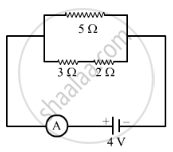
(a) With the help of a circuit diagram, obtain the relation for the equivalent resistance of two resistances connected in parallel.
(b) In the circuit diagram shown below, find:
(i) Total resistance.
(ii) Current shown by the ammeter A
You can given one hundred 1 Ω resistors. What is the smallest and largest resistance you can make in a circuit using these?
How does the heat H produced by a current passing through a fixed resistance wire depend on magnitude of current I?
In the network shown in the following adjacent Figure, calculate the equivalent resistance between the points.
- A and B
- A and C

Give the electric current unit.
Common sources of Alternating Current (AC) are:
