Advertisements
Advertisements
Question
Advertisements
Solution
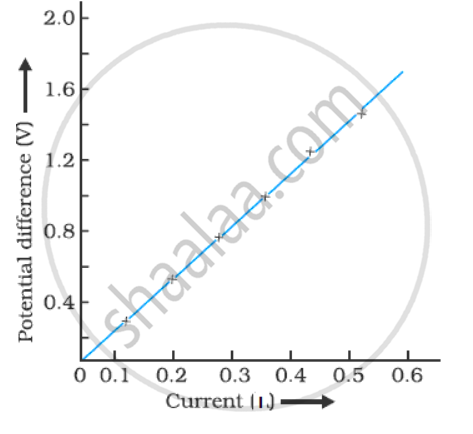
At constant temperature, if current is plotted against potential difference, the plot will be a straight line making some slope with the x-axis as shown in figure below:
APPEARS IN
RELATED QUESTIONS
In which direction do electrons flow?
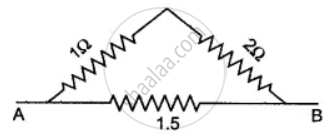
Calculate the effective resistance between the points A and B in the network shown below in Figure 8.45
Complete the following sentence:
Fuse wire has a ............ Melting point and it is made of an alloy of ......... and if the current in a circuit rises too high, the fuse wire ...........
Calculate the amount of energy transferred by a 10 A electric current flowing through a resistor of 5 o for 15 minutes.
Two resistors of 4 Ω and 6 Ω are connected in parallel. The combination is
connected across a 6 volt battery of negligible resistance. Calculate:
( i) The power supplied by the battery,
(ii) The power dissipated in each resistor.
Fig . shows the core of a transformer and i ts input and output connections
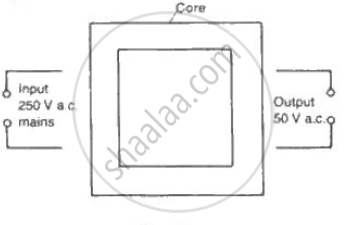
State the material used for the core and describe th e structure of the core.
(a) Use the values given in the diagram to calculate the turns ratio for the transformer and connections, labeling all parts of the diagram .
(b) If a current of 2 A is taken from th e output, calculate th e current in the input circuit (Assume the transformer to be ideal ).
Define the term kilowatt - hour and state its value in S.I. unit.
Unit of electric power may also be expressed as
What is the rate at which charges flow past a point on a circuit?
