Advertisements
Advertisements
Question
In which direction do electrons flow?
Advertisements
Solution
The flow of electrons is from the negative terminal to the positive terminal of a cell.
APPEARS IN
RELATED QUESTIONS
One coulomb charge is equivalent to the charge contained in:
(a) 2.6 × 10¹⁹ electrons
(b) 6.2 × 10¹⁹ electrons
(c) 2.65 × 10¹⁸ electrons
(d) 6.25 × 10¹⁸ electrons
Which particles constitute the electric current in a metallic conductor?
A current of 4 A flows around a circuit for 10 s. How much charge flows past a point in the circuit in this time?
Write down the formula which relates electric charge, time and electric current
Ten bulbs are connected in a series circuit to a power supply line. Ten identical bulbs are connected in a parallel circuit to an identical power supply line.
(c) In which circuit, if one bulb blows out, all other will stop glowing?
Which effect of current is utilised in the working of an electric fuse?
A given wire of resistance 1 Ω is stretched to double its length. What will be its new resistance?
Calculate the effective resistance between the points A and B in the network shown below in Figure 8.45
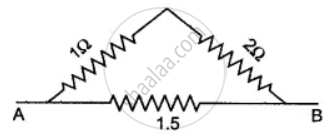
Find the effective resistance in the following circuit diagrams (Fig.):
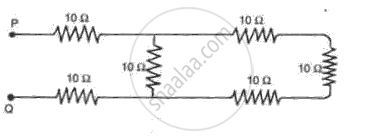
What is the purpose of a fuse in an electrical circuit?
An electric oven is rated as 1.5 kW, 250 V. If it is connected to a 250 V mains, calculate the
(a) Current drawn,
(b) Energy consumed in 20 hours,
(c) Cost of energy consumed in 20 hours at the rate of Re. 1 per unit.
A bulb of 40 W is used for 12.5 h each day for 30 days. Calculate the electrical energy consumed.
How is direction of current related to the direction of flow of electrons?
What is the speed of electric current?
State whether true or false. If false, correct the statement.
Current can produce magnetic field.
Conventional current is defined as the direction in which which type of charge would flow?
The magnitude of Alternating Current (AC):
