Advertisements
Advertisements
Question
Advertisements
Solution
Factors on which the resistance of a conductor depends are:
(i) Nature of conductor: different materials have different concentration of free electrons and therefore resistance of a conductor depends on its material.
(ii) Length of conductor: Resistance of a conductor is directly proportional to the length of a conductor.
(iii) Area of cross-section of a conductor: Resistance of a conductor is inversely proportional to the area of cross-section of the uniform wire.
(iv) Temperature of conductor: In general for metallic conductors, higher the temperature larger is the resistance.
Materials which allow electric charges to flow through them easily are known as conductors. E.g. metals and materials which do not allow the electric charge to flow through them are known as insulators. E.g. rubber, dry wood etc.
APPEARS IN
RELATED QUESTIONS
How many milliamperes as there in 1 ampere?
What is an Ammeter? How is It Connected in a Circuit? Draw a Diagram to Illustrate Your Answer.
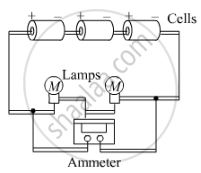
A student made an electric circuit shown here to measure the current through two lamps.
Are the lamps in series or parallel?
(a) Are the lamps in series or parallel?
(b) The student has made a mistake in this circuit. What is the mistake?
(c) Draw a circuit diagram to show the correct way to connect the circuit. Use the proper circuit symbols in your diagram.
A 5 V battery is connected to two 20 Ω resistors which are joined together in series.
(a) Draw a circuit diagram to represent this. Add an arrow to indicate the direction of conventional current flow in the circuit.
(b) What is the effective resistance of the two resistors?
(c) Calculate the current that flows from the battery?
(d) What is the p.d. across each resistor?
Ten bulbs are connected in a series circuit to a power supply line. Ten identical bulbs are connected in a parallel circuit to an identical power supply line.
- Which circuit would have the highest voltage across each bulb?
- In which circuit would the bulbs be brighter?
- In which circuit, if one bulb blows out, all others will stop glowing?
- Which circuit would have less current in it?
A switch must be connected in ______.
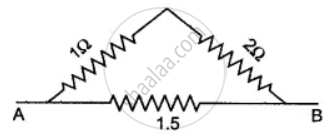
Calculate the effective resistance between the points A and B in the network shown below in Figure 8.45
Two resistors P and Q of the same material and length but of different thickness are connected in parallel to a battery. The cross- sectional area of P is twice that of Q. What is the ratio of
(a) The resistance of P to the resistance of Q?
(b) The current in P to the current in Q?
An electrical appliance is rated at 1000 KVA, 220V. If the appliance is operated for 2 hours, calculate the energy consumed by the appliance in: (i) kWh (ii) joule.
By convention, the direction of electric current in the external circuit is taken as:
