Advertisements
Advertisements
प्रश्न
Advertisements
उत्तर
Factors on which the resistance of a conductor depends are:
(i) Nature of conductor: different materials have different concentration of free electrons and therefore resistance of a conductor depends on its material.
(ii) Length of conductor: Resistance of a conductor is directly proportional to the length of a conductor.
(iii) Area of cross-section of a conductor: Resistance of a conductor is inversely proportional to the area of cross-section of the uniform wire.
(iv) Temperature of conductor: In general for metallic conductors, higher the temperature larger is the resistance.
Materials which allow electric charges to flow through them easily are known as conductors. E.g. metals and materials which do not allow the electric charge to flow through them are known as insulators. E.g. rubber, dry wood etc.
APPEARS IN
संबंधित प्रश्न
You can given one hundred 1 Ω resistors. What is the smallest and largest resistance you can make in a circuit using these?
Ten bulbs are connected in a series circuit to a power supply line. Ten identical bulbs are connected in a parallel circuit to an identical power supply line.
(d) Which circuit would have less current in it?
Using the circuit given below, state which of the following statement is correct?
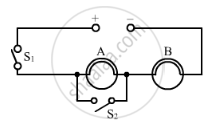
(a) When S1 and S2 are closed, lamps A and B are lit.22
(b) With S1 open and S2 closed, A is lit and B is not lit.
(c) With S2 open and S1 closed A and B are lit.
(d) With S1 closed and S2 open, lamp A remains lit even if lamp B gets fused.
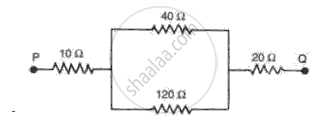
Find the effective resistance in the following circuit diagrams (Fig.):
Kilowatt hour is the unit of
Match the following:
| 1. | 1 mA | a. | series |
| 2. | 1 pA | b. | ohmmeter |
| 3. | Ammeter | c. | 10-6 ampere |
| 4. | Electrical resistivity | d. | 10-3 ampere |
What are the effects of electric current?
The direction of Direct Current (DC) is characterized as:
