Advertisements
Advertisements
प्रश्न
Advertisements
उत्तर
According to Ohm's law, the current flowing in a conductor is directly proportional to the potential difference across its ends provided the physical conditions and temperature of conductor remains constant.
Limitations of Ohm's law:
1. Ohm's law does not apply to conductors such as diode, radio valves, metal rectifiers, where electricity passes through gases.
2. Ohm's law is applicable only when the physical conditions remain constant.
3. Ohm's law is applicable only when the temperature of the conductor is constant.
APPEARS IN
संबंधित प्रश्न
What will be the change in the current if the potential difference is kept constant and the resistance of the circuit is made four times?
- It will remain unchanged.
- It will become four times.
- It will become one-fourth.
- It will become half.
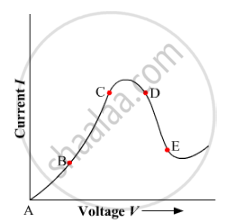
Graph showing the variation of current versus voltage for a material Ga As is shown in the figure. Identify the region of
(i) negative resistance
(ii) where Ohm's law is obeyed.
The resistors R1, R2, R3 and R4 in the figure given below are all equal in value.
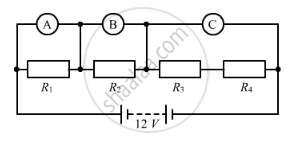
What would you expect the voltmeter A, B and C to read assuming that the connecting wires in the circuit have negligible resistance?
In an experiment of verification of Ohm’s law following observations are obtained.
|
Potential difference V (in volt) |
0.5 | 1.0 | 1.5 | 2.0 | 2.5 |
| current I (in ampere) | 0.2 | 0.4 | 0.6 | 0.8 | 1.0 |
Draw a V-I graph and use this graph to find:
- the potential difference V when the current I is 0.5 A,
- the current I when the potential difference V is 0.75 V,
- the resistance in a circuit.
How does an increase in the temperature affect the specific resistance of a semiconductor?
Define temperature coefficient of resistance.
A student carries out an experiment and plots the V-I graph of three samples of nichrome wire with resistances R1, R2 and R3 respectively. Which of the following is true?

You are provided with a resistor, a key, an ammeter, a voltmeter, four cells of 1.5 V each and few connecting wires. Using circuit components, draw a labelled circuit diagram to show the setup to study Ohm's law.
State the relationship between potential difference (V) across the resistor and the current (I) flowing through it. Also draw V-I graph, taking V on the X-axis.
The resistance of a resistor is reduced to half of its initial value. If other parameters of the electrical circuit remain unaltered, the amount of heat produced in the resistor will become ______.
A resistor is connected in a circuit with a voltage of 12 V and a resistance of 24 Ω. What is the current flowing through the resistor?
